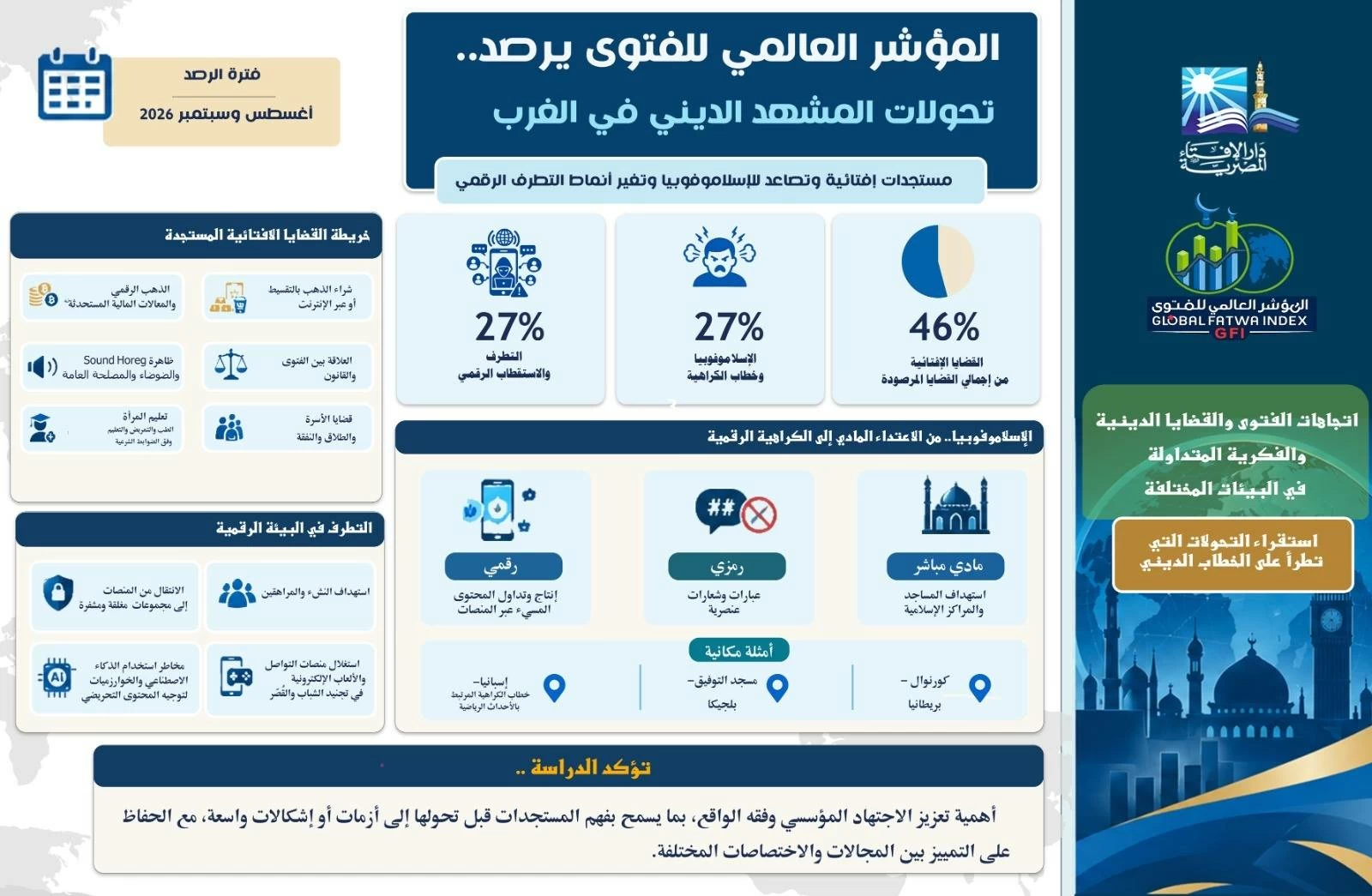
The Global Fatwa Index (GFI), affiliated with the Egyptian Dar Al-Ifta and the General Secretariat of Islamic Fatwa Authorities worldwide, has released a report highlighting trends in fatwa and religious issues from August to September 2026. The report reveals a notable increase in religious and social issues in the West, with a significant proportion of cases related to extremism, hate speech, and digital polarization. This shift reflects the evolving nature of religious discourse in Western societies.
According to the GFI report, fatwa-related issues accounted for approximately 46% of cases observed during August and September. In contrast, issues related to Islamophobia and hate speech comprised around 27%, matching the percentage of cases linked to extremism and digital polarization. The report also notes that August saw a slightly higher number of cases (52%) compared to September (48%). This distribution indicates a complex and dynamic landscape of religious and social issues.
The report highlights several notable cases from various countries. In Indonesia, the National Sharia Council of the Indonesian Ulema Council updated its fatwa on digital gold transactions, addressing issues such as gold purchases via the internet and financial products linked to gold. In India, the Supreme Court of Madhya Pradesh ruled that fatwas do not have the power of judicial decisions and cannot be used as sole evidence to prove the termination of a marriage.
The GFI report also documents instances of Islamophobia, ranging from physical attacks on Islamic centers to online hate speech. In Britain, the Islamic Center in Cornwall was vandalized in September, while in Belgium, the Al-Tawfiq mosque was subjected to repeated attacks, including anti-Islamic graffiti and Nazi slogans. A report by the Spanish Observatory on Racism and Xenophobia found over 54,000 instances of hate content online between June 11 and July 21, 2026.
The report emphasizes the growing concern of digital extremism, with online platforms and social media becoming increasingly used for radicalization and recruitment. In Portugal, a coordinated European security operation uncovered 132 extremist content pieces on Telegram and over 4,300 electronic links promoting extremist material. In Germany, authorities have focused on preventive measures in schools to counter extremist influence.
The GFI report underscores the importance of adapting to the changing landscape of religious and social issues. It highlights the need for effective monitoring and analysis tools to address emerging challenges. The report also emphasizes the role of fatwa in addressing contemporary social and economic issues, as well as the importance of collaboration between religious authorities and law enforcement agencies.
The report concludes that the intersection of fatwa, law, and social issues in Western societies presents a complex challenge. Muslims in these societies must navigate multiple reference points, balancing their religious obligations with civil laws and procedures. The GFI report provides valuable insights into these dynamics, emphasizing the need for nuanced understanding and effective responses to emerging issues.
Key points
- The Global Fatwa Index reports a significant rise in religious and social issues in the West.
- 27% of cases are linked to extremism and hate speech.
- The report highlights the growing concern of digital extremism and the need for effective monitoring and analysis tools.