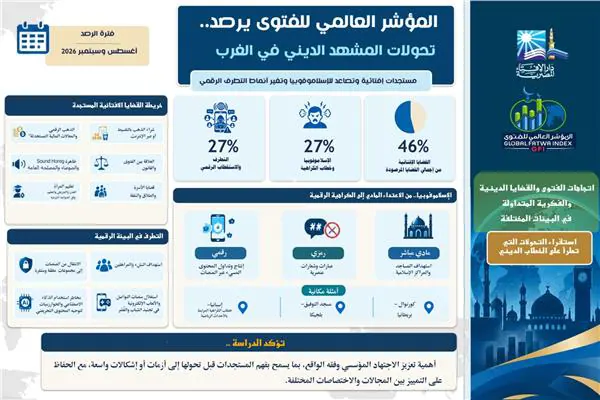
The Global Fatwa Index (GFI), affiliated with the Egyptian Dar Al-Ifta and the General Secretariat of Islamic Fatwa Institutions worldwide, released a report on trends in fatwa and religious issues. The report, covering August and September 2026, highlights the escalating challenges of Islamophobia, digital extremism, and evolving fatwa issues. The GFI monitors fatwa trends, religious and intellectual issues, and Islamophobia, analyzing the interaction between religious discourse and social, legal, and technological changes.
The report reveals that fatwa issues accounted for 46% of the total tracked cases, reflecting the growing role of fatwa in addressing social, economic, and technological developments. In contrast, Islamophobia and hate speech cases constituted 27%, while extremism and digital polarization cases also made up 27%. August accounted for 52% of the total tracked cases, with September making up 48%, indicating a dynamic landscape with multiple concurrent trends.
The report notes that fatwa issues have expanded beyond traditional areas such as worship and personal status to include digital transactions, financial products, women's education, family matters, and social and recreational practices. This shift underscores the need for religious institutions to adapt and develop tools to address emerging issues effectively. The GFI's findings highlight the intersection of fatwa questions with social, legal, and technological transformations.
The report highlights several notable cases, including a discussion by Indonesia's National Sharia Council on updating fatwa related to digital gold transactions and e-commerce. In India, the Supreme Court of Madhya Pradesh ruled that fatwa does not have the power of judicial decree and cannot be used as sole evidence to prove the termination of marriage. In Pakistan, a fatwa by Dar Al-Ulum Karachi emphasized the permissibility of women's education in fields such as medicine and nursing.
The report also documents instances of Islamophobia, including physical attacks on mosques and Islamic institutions in the West. The Islamic Center in Cornwall, UK, was vandalized in September, while the Al-Tawfiq mosque in Belgium faced repeated attacks with anti-Islamic and Nazi slogans. In Spain, a report recorded 54,771 instances of hate content online, with 52% linked to the World Cup and 88% targeting individuals of North African origin.
The report warns of the growing threat of digital extremism, with extremist content proliferating on social media platforms, online games, and messaging apps. A coordinated European security operation uncovered 132 extremist content pieces on Telegram and over 4,340 extremist links. The report emphasizes the need for a multi-faceted response, including technical monitoring, intellectual fortification, and parental and educational involvement.
The report concludes that the intersection of fatwa and law is becoming increasingly complex, with diverse references and frameworks governing the lives of Muslims in the West. Countries such as India, South Africa, and the UK are grappling with the implications of fatwa and Islamic law in their legal systems. The report underscores the importance of informed and nuanced understanding of these issues to address the evolving challenges facing Muslim communities.
Key points
- The Global Fatwa Index reports a rise in Islamophobia and digital extremism.
- Fatwa issues now account for 46% of tracked cases, reflecting the growing role of fatwa in addressing social, economic, and technological developments.
- The report highlights the need for a multi-faceted response to address the evolving challenges of Islamophobia and digital extremism.