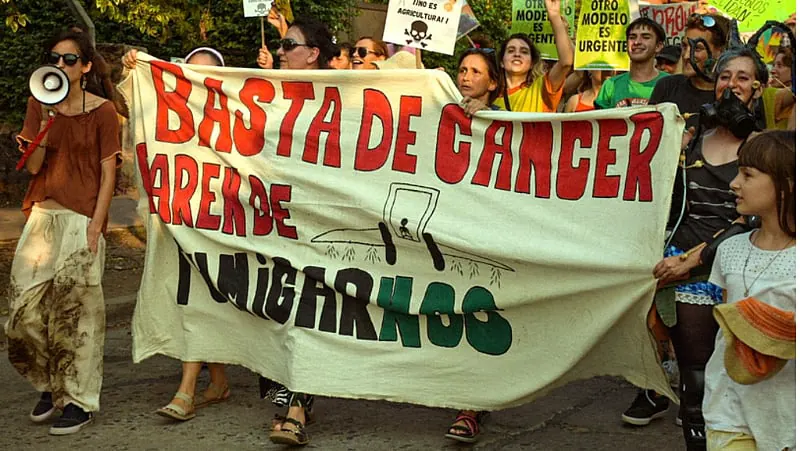
Farmers and organisations from countries including Pakistan, Argentina, and Kenya have joined a global mobilisation against what they describe as "chemical colonisation" by powerful agrochemical firms. The campaign, which is also being supported by French organisations, aims to raise awareness about the use of pesticides that are banned in developed countries but are still being exported to and used in the Global South.
According to Fleur Breteau, founder of Cancer Colère, one of the French organisations behind the campaign, pesticides are manufactured in France and exported to the Global South by companies who know full well that these pesticides contain molecules banned in their own country. Breteau, who is battling breast cancer for a second time, described the situation as a form of "chemical colonisation" where companies are making money in breach of French regulations and in defiance of human rights laws.
In Argentina, Agustín Brun, an activist with Exaltacion Salud, a group fighting the use of chemical pesticides, also supports the campaign. Brun lives in Exaltacion de la Cruz in Buenos Aires province, a town closely surrounded by fields heavily sprayed with pesticides. He said that the European Union and China, big buyers of Argentine grains, export pesticides – some of which are banned in their own countries – while importing commodities at a cheaper price without having to face the socio-environmental costs and health issues of pesticide contamination at home.
The health concerns in Argentina are significant, with a landmark study by researchers at the National University of Rosario Faculty of Medical Sciences finding that young people living in agricultural villages exposed to pesticide fumigation were 2.5 times more likely to develop and die from cancer than those living in areas unexposed to agrochemicals. Brun said that in his town, several members of their groups have died of cancer, and scientific evidence has linked atrazine exposure to cancer.
Atrazine, which was first developed by agrochemical company Syngenta, has been banned in 60 countries, including across the European Union. Syngenta is one of four global giants in the seed and pesticide sector, alongside BASF, Bayer, and Corteva. The company has responded to the criticism, saying that farmers must be able to rely on a range of solutions and technologies to address the interconnected challenges of agricultural production, climate change, and food security.
The global mobilisation, which is taking place on October 3, will see protests and actions planned in countries including Costa Rica, Pakistan, the United States, Belgium, and Indonesia, as well as Hawaii. In Kenya, Susan Owiti of the Kenyan Peasants League described the sale of banned pesticides in poorer countries as a form of chemical colonisation, saying that "whoever feeds you, controls you." The Kenyan Peasants League is taking part in the mobilisation on social media, planning a "Twitter storm" and Facebook posts to raise awareness about pesticides.
The campaign has sparked a significant response, with millions of people expected to participate. Breteau said that the anger and helplessness felt by farmers and communities affected by pesticide contamination can be turned into a powerful force for change. The protests aim to highlight the immense power wielded by the four giants of pesticide and seed manufacturing, and to push for a ban on the use of banned pesticides in the Global South.
Key points
- Agrochemical firms are exporting pesticides banned in their own countries to the Global South, where they are used on food crops, posing significant health risks to local communities.
- The global mobilisation aims to raise awareness about the issue of "chemical colonisation" and to push for a ban on the use of banned pesticides in the Global South.
- Farmers and organisations from over 10 countries are participating in the mobilisation, which includes protests, social media campaigns, and awareness-raising activities.