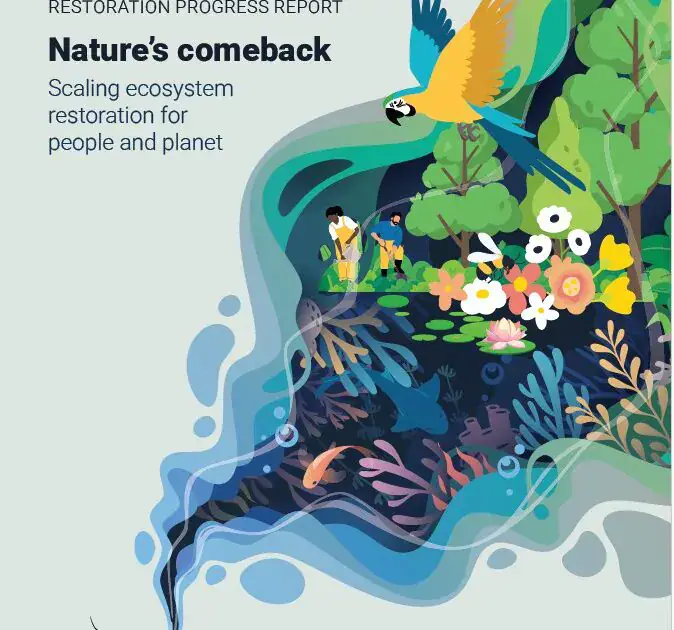
A recent United Nations report, Nature's Comeback – Scaling Ecosystem Restoration for People and Planet, reveals that global efforts to restore degraded ecosystems have reached 252 million hectares across 149 countries. This has resulted in the creation of over 1 million green jobs. The report, jointly produced by the Food and Agriculture Organisation of the United Nations (FAO), the UN Environment Programme (UNEP), and the Secretariat of the Convention on Biological Diversity (CBD), provides the first comprehensive global assessment of progress towards commitments to restore approximately 1 billion hectares of degraded land and ecosystems.
The report highlights significant differences in the geographical distribution of restoration activities. Asia accounts for 192.2 million hectares of the total documented area, making it the largest contributor, followed by Africa with 36.3 million hectares. Europe has 9.1 million hectares under restoration, while North and Central America account for 5.8 million hectares. South America has 5.4 million hectares, with Oceania recording 3.2 million hectares. China has reported the largest terrestrial restoration area, 127.4 million hectares, while Mongolia and Kazakhstan have also documented substantial areas.
Despite progress, the report warns that current interventions still fall short in scale and pace. UNEP Executive Director Inger Andersen emphasized that countries and communities are beginning to make significant progress in reversing environmental degradation. However, she warned that restoration efforts must be scaled up, particularly in freshwater, marine, and coastal ecosystems. The report estimates that scaling up restoration financing could create as many as 32 million additional jobs worldwide by 2030.
The report identifies freshwater, marine, and coastal ecosystems as major areas of concern. Only 11 million hectares of freshwater ecosystems across 62 countries and 5.7 million hectares of marine and coastal ecosystems across 46 countries are currently documented as being under restoration. However, progress is evident in wetland protection, with the share of countries reporting implemented wetland restoration or rehabilitation programmes rising from 8% in 2022 to 54%.
Ecosystem restoration presents significant opportunities for employment, food security, and economic development. Healthy ecosystems are essential for maintaining water supplies, supporting agricultural production, strengthening climate resilience, and improving livelihoods. Research cited in the report indicates that restoring just 15% of global priority areas could capture and store carbon dioxide equivalent to 30% of emissions released since the Industrial Revolution.
The report estimates that annual investment in ecosystem restoration must rise from $64 billion to $296 billion by 2030. This represents more than a fourfold increase in financing over the next four years. The largest estimated annual investment requirement is for agroforestry, at $87 billion, followed by restorative reforestation at $52 billion. Peatland restoration will require an estimated $44 billion annually, while seagrass restoration needs $28 billion.
FAO Director-General QU Dongyu emphasized that restoration interventions can deliver results, but the challenge now is to make restoration an integral part of sustainable land, water, and natural resource management. He stressed that healthy ecosystems are vital for better production, better nutrition, a better environment, and a better life for all, leaving no one behind. Governments are urged to address the causes of degradation and significantly increase restoration efforts to meet international commitments to reverse nature loss by 2030.
Key points
- The global effort to restore degraded ecosystems has reached 252 million hectares across 149 countries, generating over 1 million green jobs.
- The report warns that progress remains insufficient to meet 2030 targets, and governments must significantly increase restoration efforts, particularly in freshwater, marine, and coastal ecosystems.
- Scaling up restoration financing could create as many as 32 million additional jobs worldwide by 2030.