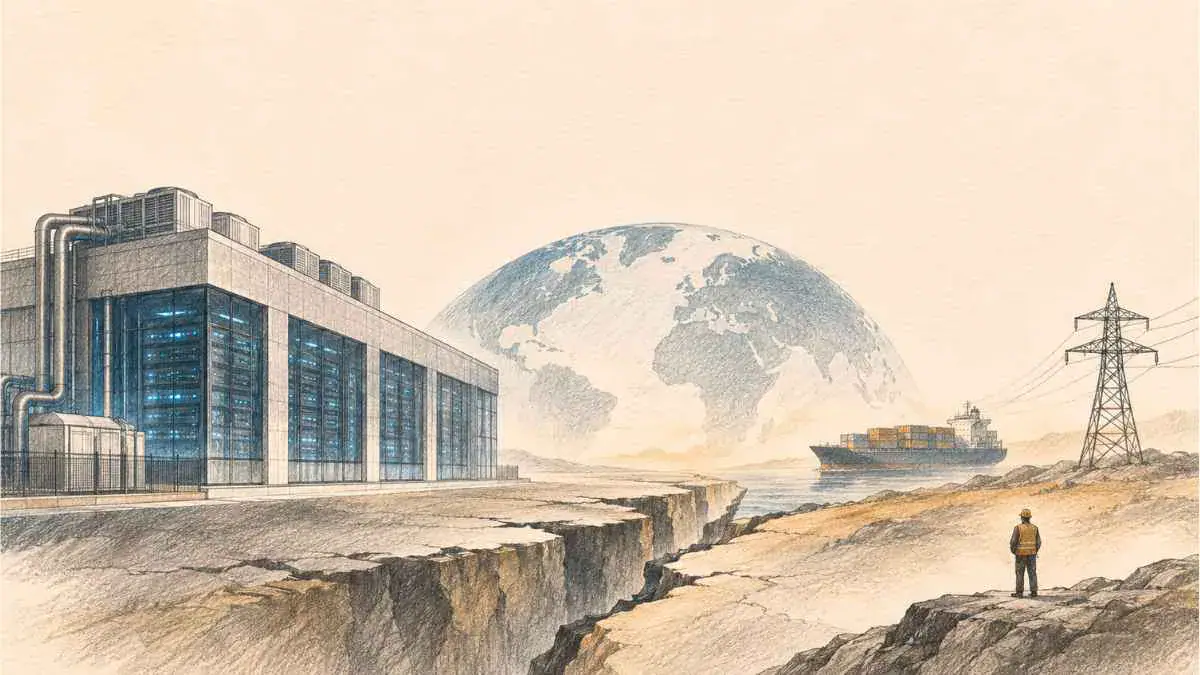
The global economy is navigating a line of fracture, marked by significant investments in artificial intelligence and strategic infrastructure, but also facing rising geopolitical, energy, and social tensions. These tensions highlight that financial power does not guarantee economic stability or security. The ongoing investments in AI and infrastructure underscore the contradiction between technological advancements and emerging challenges.
Google has announced a $17 billion investment in its first data center in Wyoming, demonstrating the strategic importance of digital infrastructure. However, this massive capital mobilization raises essential questions about the limits of technological progress without encountering energy, financial, and territorial constraints. The investment also highlights the growing importance of AI in the global economy.
The Chinese government's decision to block the acquisition of ABB's robotics division by SoftBank illustrates the increasing role of technology in sovereignty. This move demonstrates that regulatory control can significantly impact large international industrial operations. As a result, the globalization of investments is facing increasingly visible political borders.
The energy sector is experiencing a similar transformation, with countries diversifying their portfolios to reduce exposure to regional disruptions. The Qatar government's efforts to secure more liquefied natural gas from the US and the United Arab Emirates' expansion of its international portfolio reflect this new priority. The focus is now on securing supplies rather than solely pursuing the best commercial terms.
The global supply chain is under pressure, with congestion, port disruptions, and technological restrictions between Washington and Beijing complicating the circulation of goods and strategic equipment. In the US, the creation of 165,000 non-agricultural jobs in October is a positive signal, but long-term unemployment remains high.
The global food market has seen a slight decrease in prices in October, at 1.2%, but the annual progression remains at 5.9%. According to the FAO, 41 countries and territories require external food assistance, including 31 in Africa. This highlights the ongoing challenges in ensuring food security and the need for sustained support.
The real economic challenge is no longer just about mobilizing capital or producing more, but about building growth that can withstand technological, geopolitical, and social disruptions without leaving vulnerable populations to bear the costs alone. The international community must address these challenges to ensure sustainable and equitable growth.
Key points
- 17 billion dollars invested by Google in its first data center in Wyoming
- 165,000 non-agricultural jobs created in the US in October
- 41 countries and territories require external food assistance, including 31 in Africa