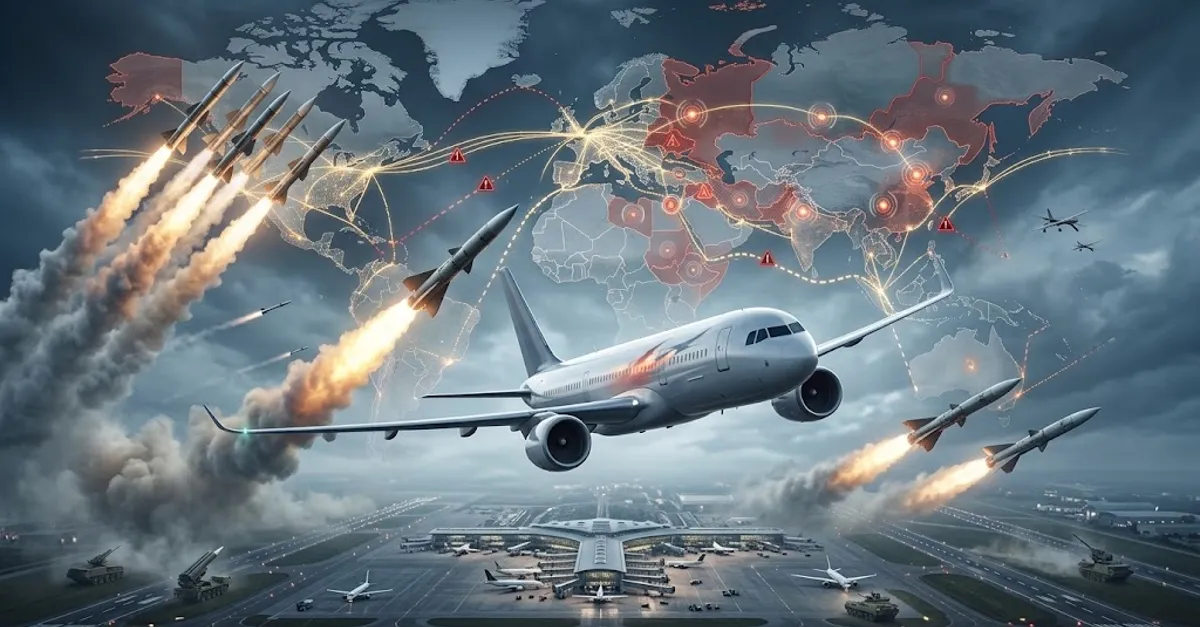
The surge in attacks on airports and aviation infrastructure has raised concerns about the safety of global air travel. Recent attacks by Houthi rebels on Riyadh's airport in Saudi Arabia have resulted in fatalities and injuries, prompting airlines to reroute dozens of flights and cancel over 1,000 others. This incident is considered one of the worst direct missile attacks on a civilian airport.
The ongoing conflict between the US, Israel, and Iran has led to repeated attacks on major airports in the Middle East, resulting in damage to aircraft and airport infrastructure, as well as loss of life. Governments of the US, UK, and Australia have advised their citizens to avoid Riyadh's airport, while France, Canada, and Germany have warned airlines that flying over Saudi Arabia is no longer safe.
Since late February, Iran has targeted major airports in Dubai, Qatar, Bahrain, Kuwait, and elsewhere, causing damage to fuel tanks, aircraft, and air traffic control systems. In response, Israel has carried out airstrikes on sites in Beirut, while coalition forces have targeted the Yemeni airport in Sana'a.
The international community has expressed concern over the escalating threats to aviation. The International Civil Aviation Organization (ICAO), a UN agency responsible for regulating global aviation, has urged its member states to prevent the involvement of the aviation sector in hostilities. The organization warned that the ability of airlines to change routes and continue operating during conflicts does not address the underlying security threat.
The European Aviation Safety Agency has issued a warning about flying over parts of Saudi Arabian airspace, following a similar alert by the Houthi rebels. The rebels have stated that Saudi airspace will become a "theater of operations" for their forces.
The restrictions have put pressure on one of the few remaining air corridors between Europe and Asia. Airlines have had to constantly adjust their routes to navigate around conflicts, making air travel more expensive. The closure of Ukrainian airspace in 2022 and Russia's ban on European and American airlines from using its airspace have further complicated matters.
As a result, airlines are relying on a narrow air corridor over Georgia, Azerbaijan, and Turkmenistan. This alternative route is becoming increasingly congested and poses risks, including the potential for the Russian-Ukrainian conflict to spill over.
Key points
- Increased attacks on airports and aviation infrastructure have disrupted global air travel.
- Governments and international organizations have warned of the risks of flying over certain regions.
- Airlines are being forced to adjust routes and navigate through narrow air corridors, increasing costs and risks.