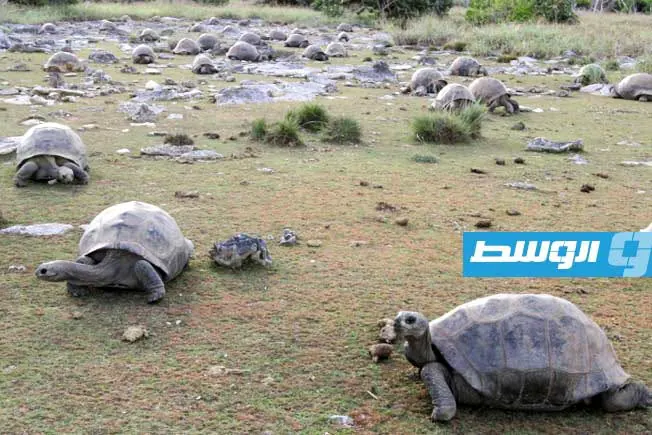
The Seychelles archipelago has witnessed a notable resurgence in its giant tortoise population, with numbers surpassing that of the human population for the first time in centuries. A recent study revealed that over 180,000 tortoises roam the island of Aldabra, a coral atoll. This achievement reflects the success of decades-long conservation efforts. Prior to European explorers' arrival, the Seychelles provided a safe haven for wildlife due to its geographical isolation and lack of natural predators.
Before European explorers arrived in the 15th century, the Seychelles was a safe haven for wildlife. The giant tortoises, known scientifically as Aldabrachelys gigantea, enjoyed long lifespans without needing to be speedy or aggressive. However, with the increase in sea voyages, their numbers gradually declined as they became an easy food source for sailors and pirates. By the 19th century, only less than 1,000 tortoises remained on Aldabra.
Conservation efforts led to the recovery of the giant tortoise population. In 1981, Aldabra was declared a strict nature reserve, and in 1982, it was listed as a UNESCO World Heritage Site. The recent study is the first comprehensive and accurate survey of the tortoise population on the island since the 1990s. According to Frauke Fleischer-Dogle, CEO of the Seychelles Islands Foundation, the 180,000 tortoises demonstrate the long-term success of continuous conservation efforts.
The study used statistical models to estimate the number of tortoises that were not directly observed, providing a more reliable baseline for future monitoring. Nancy Benbree noted that dense vegetation in parts of the island made it difficult to count the tortoises. Researchers found large gatherings of tortoises in open grasslands known as "tortoise meadows," which the animals maintain through continuous grazing.
Despite this recovery, giant tortoises still face increasing threats, including rising sea levels and droughts caused by climate change, as well as feral cats and black rats that prey on tortoise eggs and hatchlings. David Hudson, from the University of Exeter, emphasized that the current numbers represent a reference point for monitoring future changes, rather than the end of conservation efforts.
The study's findings provide a crucial baseline for monitoring the impact of environmental pressures on the tortoise population. Researchers stress the importance of using these results to take early action against increasing environmental threats. The conservation of giant tortoises in Seychelles serves as an example of successful wildlife preservation through sustained efforts.
The Seychelles' conservation story highlights the importance of protecting unique wildlife. With continued conservation efforts, the giant tortoise population can thrive, serving as a symbol of successful environmental preservation. The collaborative study involved researchers from various institutions, showcasing the value of joint efforts in achieving conservation goals.
Key points
- The giant tortoise population in Seychelles has surpassed the human population, with over 180,000 tortoises on the island of Aldabra.