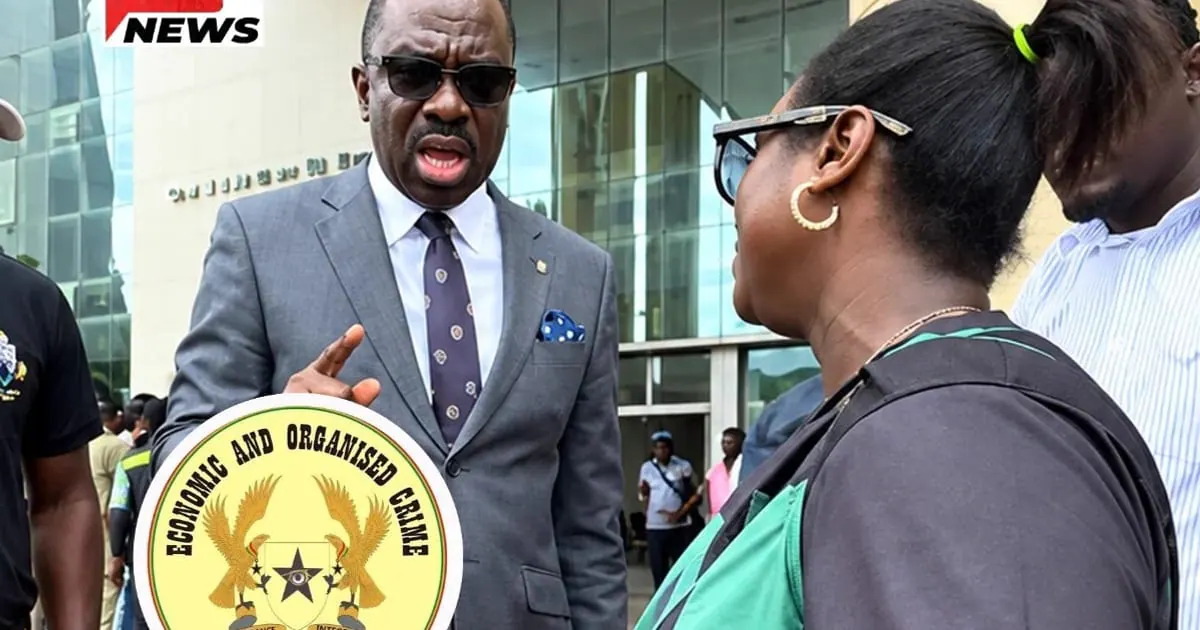
A video that has gone viral in Ghana shows a woman in plain clothes approaching Lawyer and Member of Parliament for Manhyia South Nana Agyei Baffour Awuah at the Accra High Court on September 23, 2026. The woman, who claimed to be from the Economic and Organised Crime Office (EOCO), told the MP that he was needed for questioning. The incident has sparked a national debate about the balance between law enforcement and parliamentary privilege.
According to EOCO, the MP had been invited for questioning in February 2026, but he failed to honour the invitation. EOCO released a statement explaining that they had addressed two letters to the MP's law firm, Sarkodie Baffour Awuah & Partners, inviting him to assist with investigations into a client of the firm, SIC Life Savings and Loans. The MP claims he replied to the letter, stating that he had referred it to the Clerk of Parliament for advice.
The MP further claims that a partner in his law firm, Theresa Terbi, attended EOCO three times, providing a full written statement. However, EOCO allegedly went quiet until the attempted arrest on September 23. The MP was at the High Court representing a client, Salomey Baffoe Awiti, who is being held for abetment in a case involving a TikToker known as Ghana Jollof. EOCO has denied any link between the MP's defence of the nurse and the attempted arrest.
The incident has raised questions about the privileges of Ghanaian MPs. Article 117 of the Constitution states that MPs are not to be served with civil or criminal processes while attending parliamentary proceedings or travelling to and from such proceedings. However, it is unclear whether the MP was on his way to a parliamentary proceeding at the time of the attempted arrest. The MP claims he was heading to a committee meeting, but it is unclear if such a meeting was scheduled.
The Speaker of Parliament, Bagbin, has clarified that security agents do not need his permission to arrest or invite an MP for questioning. However, they must inform him of the circumstances and allegations surrounding the arrest. Section 10 of the Criminal Procedure Act, Act 30, states that an arrest can be made without a warrant if there is reasonable suspicion that a person has committed an offence.
The attempted arrest has also raised concerns about the lawfulness of the procedure. An arrest must be done lawfully, with the officer identifying themselves and providing reasons for the arrest. In this case, the woman from EOCO failed to follow this procedure. The incident has sparked a national debate about how to balance law enforcement with parliamentary privilege and ensure that the law is enforced lawfully.
The case is now expected to go to court, where it will be clarified whether the attempted arrest was lawful and whether the MP's privileges as a member of parliament were breached. The incident has significant implications for the relationship between law enforcement agencies and the Ghanaian parliament.
Key points
- The incident has sparked a national debate about the balance between law enforcement and parliamentary privilege in Ghana.
- The MP claims he was heading to a committee meeting at the time of the attempted arrest, which could affect the applicability of Article 117 of the Constitution.
- The lawfulness of the arrest procedure has been questioned, with concerns raised about the failure to identify the officer and provide reasons for the arrest.