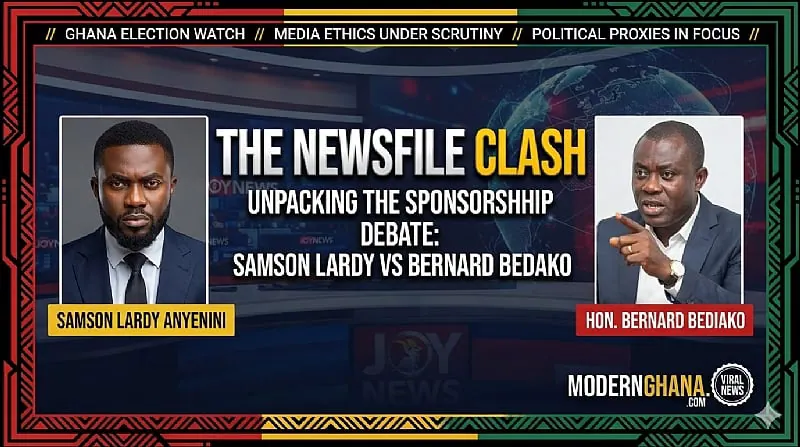
A recent episode of JoyNews' flagship current affairs program, NewsFile, turned into a fierce clash between host Samson Lardy Anyenini and National Democratic Congress (NDC) Member of Parliament for Akwatia, Bernard Bediako Baidoo. The confrontation centered on allegations that political entities secretly bankroll external commentators like Kevin Taylor. The incident highlights a growing national concern: the delicate balance between robust political communication, media neutrality, and discouragement of dangerous rhetoric.
The clash ignited when MP Bernard Bediako Baidoo tried to separate the harsh political commentary of US-based media personality Kevin Taylor from that of "Ghana Jollot," a commentator declared wanted by the Ghana Police Service for allegedly inciting public violence. Anyenini pushed back against attempts to rationalize aggressive media outputs, tapping into a prominent public narrative: allegations that the opposition NDC sponsors Kevin Taylor's aggressive, pro-NDC media campaigns.
As a former Journalist of the Year, Anyenini sought to maintain a strict standard on NewsFile, enforcing the principle that the media must not be used to shield or justify entities that skirt the edge of unlawful incitement. Bediako, serving as an NDC lawmaker and lawyer, was perceived as attempting to salvage the political image of the party by decoupling mainstream party leanings from loose-cannon commentators, sparking an intense back-and-forth on air.
The viral clash serves as a crucial case study for the Ghanaian electorate on how political communication operates today. Political parties increasingly rely on unaffiliated digital broadcasters to drive aggressive narratives that mainstream politicians cannot explicitly state on the record. The incident highlights the rise of proxy communicators and the need for clear party disclaimers distancing themselves from independent commentators who use violent or deeply divisive language.
The National Media Commission (NMC) must step up its monitoring of digital feeds and cross-border broadcasts that affect local peace, collaborating with internet service providers to flag clear incitement. Ghanaian citizens should learn to decouple official party positions from sensationalized content created by online political influencers whose primary metric is digital engagement rather than factual accuracy.
Media houses must follow the precedent set during this NewsFile episode—swiftly checking panellists whenever they attempt to normalize or validate rogue actors. The incident highlights the role of host neutrality and the need for standardized gatekeeping to preserve the integrity of Ghana's media landscape ahead of future political cycles.
The fiery exchange between Samson Lardy Anyenini and Hon. Bernard Bediako Baidoo is a symptom of a much larger systemic challenge in Ghanaian politics. Ghana's democratic stability relies on maintaining a clean media space, and politicians must recognize that defending toxicity for short-term partisan gain damages the wider democratic framework, and the media must remain fearless in calling it out.
Key points
- The clash highlights the need for clear party disclaimers distancing themselves from independent commentators who use violent or deeply divisive language.
- The National Media Commission (NMC) must step up its monitoring of digital feeds and cross-border broadcasts that affect local peace.
- Media houses must follow the precedent set during this NewsFile episode—swiftly checking panellists whenever they attempt to normalize or validate rogue actors.