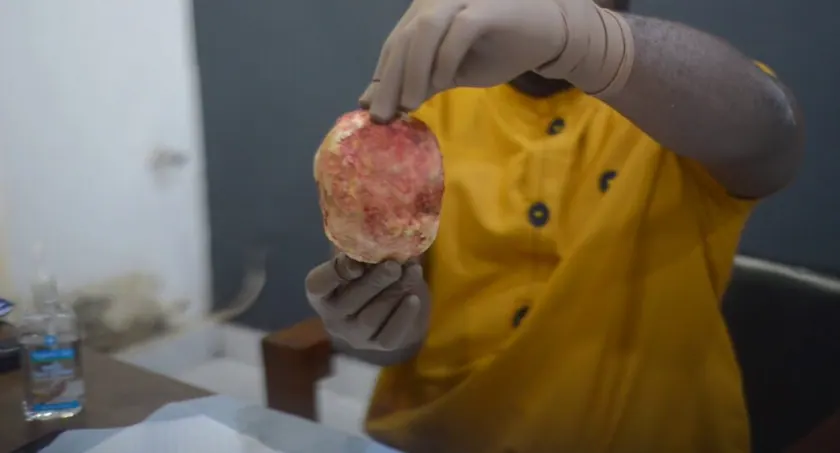
A team of surgeons at Kumasi Hospital, a private health facility in Ghana's Ashanti Region, has successfully removed an exceptionally large bladder stone from a 49-year-old man, Akoto. The stone, which weighed 880 grams and measured 11.8 cm in length, 9.5 cm in breadth, and nearly 8 cm in width, had caused Akoto nearly three decades of pain and urinary difficulties. The medical team believes this case could be one of the largest bladder stones removed in Africa.
According to Dr. Samuel Koranteng Asante, the hospital's Chief Executive Officer, the surgical team reviewed medical literature from across Africa but found no documented case of a bladder stone of comparable size that had been removed. The stone originally weighed 980 grams before drying and reduced to 880 grams after desiccating for over a day. Dr. Asante expressed confidence that this case could be one of the largest recorded in medical history.
Bladder stones are hard mineral deposits that form when urine remains in the bladder and its contents become concentrated, allowing crystals to develop and grow. Conditions that interfere with the normal flow of urine, such as prostate enlargement or ureteric stricture, can increase the risk of stone formation. In Akoto's case, a stricture in his ureter, likely caused by an untreated urinary infection, contributed to the development of the bladder stone.
The surgical team's successful removal of the bladder stone has brought relief to Akoto, who had endured years of distress and urinary difficulties. Akoto described the experience as "really painful" and expressed gratitude to the medical team for their expertise. The hospital's achievement has drawn attention to the importance of proper medical care and treatment of urinary conditions to prevent complications.
While the Kumasi team's assessment suggests that this case could be one of the largest bladder stones removed in Africa, global records indicate that larger stones have been reported. Guinness World Records lists a bladder stone weighing 1.9 kg and measuring 17.9 cm, removed from a patient in Brazil in 2003. Another report from Sri Lanka in August 2026 described the removal of a 3.1 kg bladder stone from a 55-year-old man.
The removal of the bladder stone highlights the importance of access to quality medical care, particularly in cases where patients may be experiencing urinary difficulties. Dr. Asante emphasized that conditions like prostate enlargement and ureteric stricture can contribute to bladder stone formation, emphasizing the need for prompt medical attention.
The successful surgery has not only brought relief to Akoto but also demonstrates the capabilities of the medical team at Kumasi Hospital. The hospital's achievement serves as a testament to the importance of investing in quality healthcare infrastructure and providing patients with access to specialized medical care.
Key points
- The bladder stone removed from Akoto weighed 880 grams and measured 11.8 cm in length, 9.5 cm in breadth, and nearly 8 cm in width.
- The surgical team reviewed medical literature from across Africa but found no documented case of a bladder stone of comparable size that had been removed.
- The removal of the bladder stone highlights the importance of access to quality medical care, particularly in cases where patients may be experiencing urinary difficulties.