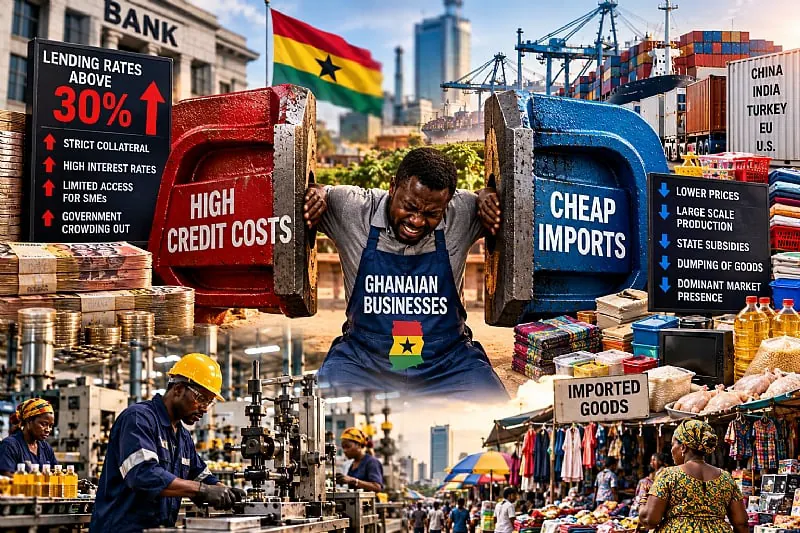
Ghanaian businesses are facing a significant challenge in balancing the high cost of financing with intense competition from cheaper imported goods. This has resulted in a squeeze on the private sector, which is expected to create jobs, expand the tax base, and drive industrialization. The high cost of credit has made it difficult for businesses to invest in long-term projects, and many entrepreneurs are finding it hard to access affordable credit.
The problem of expensive credit is particularly severe for small and medium-sized enterprises (SMEs). Commercial banks often consider SMEs risky due to a lack of collateral, audited accounts, or predictable cash flows. As a result, many SMEs are forced to turn to alternative lenders, where borrowing costs can be even higher. This has led to a situation where businesses are not borrowing to expand, but rather to survive.
Government borrowing can also exacerbate the problem. When the state relies heavily on the domestic financial market, government securities can compete with businesses for available capital. This can lead to a situation where banks prefer to invest in government instruments rather than take on the risk of financing small manufacturers.
In addition to expensive credit, Ghanaian manufacturers must also compete with imported products that are often cheaper due to lower production costs in other countries. These countries may have cheaper electricity, lower financing costs, larger markets, better infrastructure, and greater economies of scale. As a result, imported goods flood Ghanaian markets and shops, competing with domestic alternatives.
The impact of cheap imports on Ghanaian businesses cannot be overstated. When local manufacturers are forced to compete with imported goods, they often find it difficult to compete on price. This is due to a range of factors, including high borrowing costs, expensive electricity tariffs, and multiple taxes and regulatory expenses.
To address this challenge, Ghana needs an intelligent industrial policy that prioritizes sectors where the country has a genuine comparative or strategic advantage. The government should identify areas where Ghana can become internationally competitive and create the conditions for those industries to thrive. This could include providing financing mechanisms designed around productive investment, rather than short-term commercial lending.
The Ghanaian government must also exercise fiscal discipline to ensure that excessive domestic borrowing does not undermine private-sector access to capital. Furthermore, trade rules should be enforced against genuine dumping and substandard imports, while customs administration should ensure that legitimate local producers are not disadvantaged by under-invoicing or misclassification.
Key points
- High financing costs and competition from cheaper imports are major challenges facing Ghanaian businesses.
- The government needs to implement an intelligent industrial policy to support local manufacturers.
- Fiscal discipline and effective trade rules are essential to ensuring a level playing field for Ghanaian businesses.