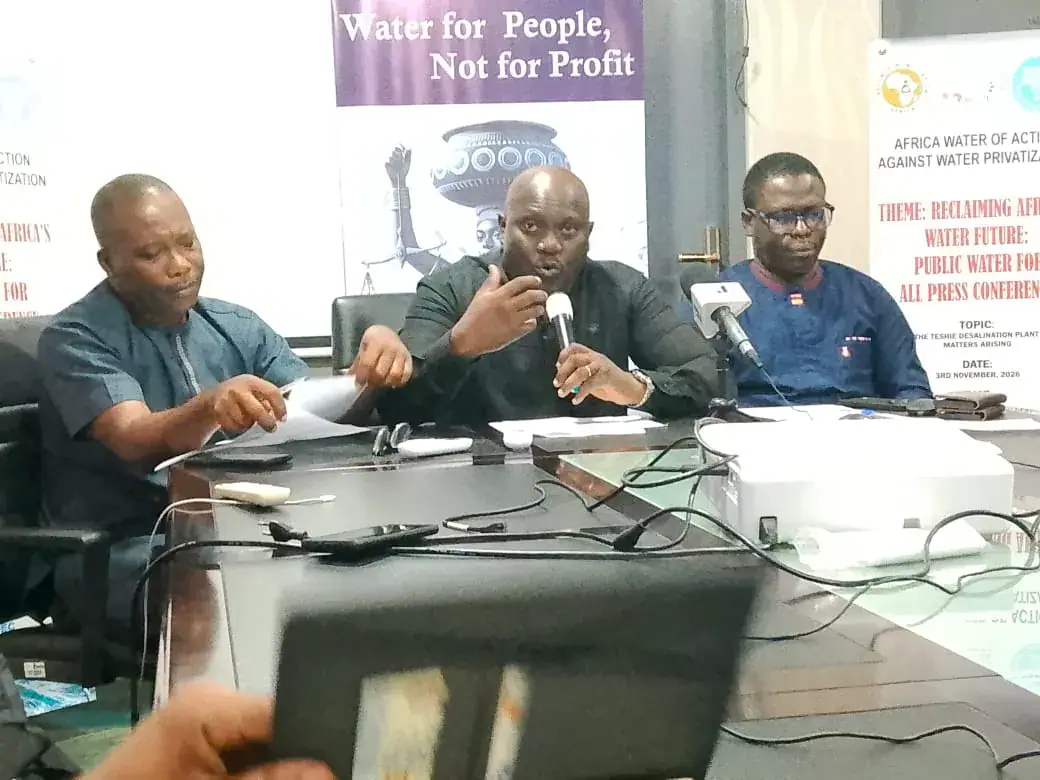
The Ghana Water Justice Network (GWJN) has expressed concerns over the financial consequences of the Teshie-Nungua Desalination Project and called on the government to halt further water privatisation initiatives. The GWJN made this call in a joint statement read at a press conference organised by the Integrated Social Development Centre (ISODEC) and other stakeholders. The press conference was on the theme, “Reclaiming Africa’s Water Future: Public Water for All Press Conference” and the topic was on the Teshie-Nungua Desalination Plant: Matters Arising.
The GWJN statement said the Teshie-Nungua Desalination Project had demonstrated the danger of arrangements that exposed the State and water consumers to substantial financial risks without corresponding public value. During the project, concerns were raised over several years, including the taste, salinity and acceptability of water from the plant. The statement said these concerns were ignored, and the consequences of flawed water-sector contracts must not be passed on to households through higher water tariffs.
The statement demanded that the government suspend further water privatisation and comparable high-risk PPP commitments pending an independent policy review. It also called for the disclosure of the Water Purchase Agreement, amendments, State Guarantee and material arbitration findings, subject to legitimate legal limits. The GWJN urged the government to prioritise public investment, accountable management of Ghana Water, infrastructure maintenance, operational efficiency and meaningful participation by workers, communities and consumers.
On 17 September 2026, an International Chamber of Commerce arbitration tribunal awarded approximately US$235 million in termination-related payments to Befesa Desalination Development Ghana Limited and Standard Bank of South Africa Limited following termination of the Water Purchase Agreement with Ghana Water. A related arbitration under the State Guarantee also principally held the Republic liable for Ghana Water’s obligations.
The GWJN statement said the Teshie-Nungua project experience was a national warning: the public must not carry disproportionate contractual risks while receiving inadequate benefits. The statement urged the government to learn from this case, protect consumers, and put publicly accountable, affordable and sustainable water provision at the centre of national policy. Water is a public good and a human right – not merely a commodity for private profit.
The press conference was supported by Tax Justice Network Africa, African Tax Forum, and the Tax Justice Coalition, and was part of the Africa Week of Action Against Water Privatisation 2026. The campaign seeks to call on African governments to desist from water privatisation. The statement was read by Mr Geoffrey Kabutey Ocansey, Executive Director, Revenue Mobilisation Africa (RMA), and supported by Mr Leonard Shang-Quartey, Africa Water Justice Network Coordinator and Mr Bernard Anaba, Head of Programmes, ISODEC.
The GWJN has urged the government to commission an independent public-interest investigation and hold proven wrongdoing accountable. The statement also called for the prevention of recovery of the arbitration-related liability through water-tariff increases imposed specifically on consumers and that government should publish independent assessments of the proposed acquisition and submit its fiscal implications to Parliament and relevant oversight institutions.
Key points
- The Ghana Water Justice Network is calling for the government to halt water privatisation initiatives, citing financial risks and lack of public value.
- The Teshie-Nungua Desalination Project has demonstrated the dangers of water-sector Public-Private Partnerships (PPPs) that expose the State and water consumers to substantial financial risks.
- The government is urged to prioritise public investment, accountable management of Ghana Water, infrastructure maintenance, operational efficiency and meaningful participation by workers, communities and consumers.