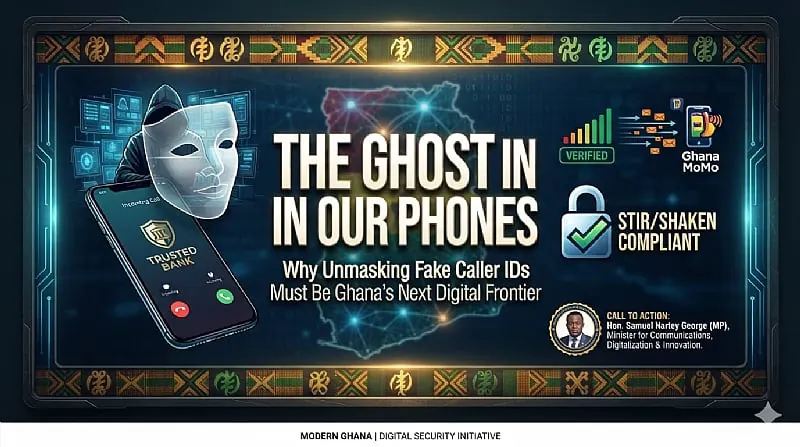
Thousands of Ghanaians fall victim to cybercriminals daily, with fake caller IDs used to steal sensitive information and empty mobile wallets. This tactic, known as Caller ID Spoofing, has led to a significant increase in digital financial crime. According to the INTERPOL African Cyberthreat Assessment Report, Ghanaians lost US$1.3 million to mobile money fraud in the first quarter of 2025. The Bank of Ghana's recent Fraud Report also revealed a 98% increase in electronic fraud incidents within the Payment Service Provider sector.
The issue lies in the country's telecommunications infrastructure, which relies on outdated signaling protocols that assume trust in caller information. With the advent of Voice over IP technology, scammers can easily set up virtual calling applications and spoof legitimate phone numbers. Non-compliant local telecom providers act as passive pipes, accepting forged caller information without verification. This allows cybercriminals to engineer localized psychological traps, including the Mobile Money Reversal Scam and Fake Law Enforcement/Court Threat.
To combat this, Hon. Samuel Nartey George, sector minister for the Ministry for Communication, Digital Technology and Innovations, must enforce international identity authentication standards. This can be achieved by implementing cryptographic call signatures and strict border rewrite rules. The North American Framework, enforced by the US Federal Communications Commission, mandates digital, encrypted fingerprints for calls, evaluating identity using strict Attestation Levels.
International best practices offer models for Ghana to follow. The European Response, for example, involves blocking calls with domestic caller IDs received via international interconnections from non-compliant operators. The ASEAN Protocol takes a hardware-based approach, controlling and restricting the import of unregulated SIM boxes used by fraudsters.
Strategic recommendations for Ghana include mandating cryptographic call signatures via the National Communications Authority and implementing strict border rewrite rules. The NCA must phase in an IP-based caller authentication standard modeled after STIR/SHAKEN for all local Mobile Network Operators. This will require a hard structural transition from passive transmission to active network policing.
The Ministry for Communication, Digital Technology and Innovations has a crucial role to play in enforcing these standards. By working with the NCA and telecom operators, the ministry can help prevent cybercriminals from exploiting the country's telecommunications infrastructure. This will require a collaborative effort to educate citizens and raise awareness about the dangers of Caller ID Spoofing.
Implementing these measures will help secure Ghana's digital economy and prevent further financial losses. The country's technology leadership must take a proactive approach to addressing this issue, rather than relying solely on educating citizens to "stay vigilant." By enforcing international identity authentication standards, Ghana can reduce the risk of cybercrime and protect its citizens' sensitive information.
Key points
- Ghana lost US$1.3 million to mobile money fraud in Q1 2025.
- The country's telecommunications infrastructure relies on outdated signaling protocols that assume trust in caller information.
- Implementing cryptographic call signatures and strict border rewrite rules can help combat Caller ID Spoofing.