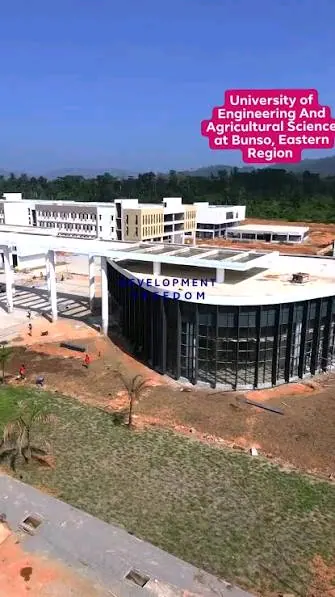
Ghana has taken a significant step towards connecting university education with agriculture, industry, and technological innovation with the unveiling of the University of Engineering and Agricultural Sciences (UEAS) at Bunso. The newly established public university is set to admit its first cohort of students for the 2026/2027 academic year. The university's campus is equipped with an expansive academic complex, engineering and agricultural laboratories, a central library, student accommodation, staff housing, a cafeteria, an exhibition hall, and facilities for research and innovation.
The university is designed to combine engineering, agricultural science, entrepreneurship, and practical problem-solving, making it the first fully-fledged public university in Ghana to integrate these disciplines. This distinction is crucial for Ghana, which continues to import significant quantities of food, machinery, and processed products despite having abundant agricultural land, raw materials, and a large youthful population. The university aims to produce engineers who understand agriculture, agricultural scientists who can work with technology, and entrepreneurs capable of converting research into commercially viable products.
The construction of the Bunso campus began in April 2022 with financial support from the Republic of Korea. The project cost is estimated to be around $90-92 million. The project was reported to be about 95% complete in January 2026. The university was initially conceived as part of the University of Environment and Sustainable Development but later evolved into an independent institution with its own specialized mandate, formalized by the University of Engineering and Agricultural Sciences Act, 2026 (Act 1169), which was assented to by President John Dramani Mahama on March 31, 2026.
The university will operate through three campuses: its main campus at Bunso in the Eastern Region and additional campuses at Ohawu and Acherensua. The Bunso campus has been constructed to support two initial academic divisions: the School of Engineering and the School of Agricultural Sciences. The facilities include student hostels designed to accommodate approximately 800 students, as well as staff accommodation and specialized teaching and research infrastructure.
The university will initially offer Bachelor of Science programs in Electrical and Electronic Engineering, Computer Engineering, Mechanical Engineering, and Industrial Engineering. The School of Agricultural Sciences will offer programs in Agronomy, Animal Science, Agricultural Economics and Agribusiness, and Food Technology and Nutrition Science. The agricultural curriculum is expected to depart from the common model, with students receiving concentrated instruction in their chosen fields from the beginning of their programs.
Professor Mark Adom-Asamoah, a former Provost of KNUST's College of Engineering and a Professor of Civil Engineering, has been appointed the foundation Vice-Chancellor. The university's Governing Council is chaired by Professor Kweku Danso Boafo. The council and core management team were inaugurated by the Minister of Education, Haruna Iddrisu, on May 12, 2026, with instructions to make the institution operational for the 2026/2027 academic year.
The university is expected to begin with approximately 800 students divided between engineering and agricultural sciences. The choice of Bunso is strategically significant, as it lies within Ghana's cocoa and oil-palm belt and is close to the Bunso Cocoa College and the Council for Scientific and Industrial Research's Plant Genetic Resources Research Institute. This gives UEAS an opportunity to turn the Eastern Region into a center for agricultural research, machinery development, food processing, and agro-industrial entrepreneurship.
Key points
- The university aims to produce graduates with greater technical depth and stronger professional competence.
- The institution must maintain strong connections with industry and surrounding communities.
- The university's success will depend on proper funding and protection from excessive political interference.