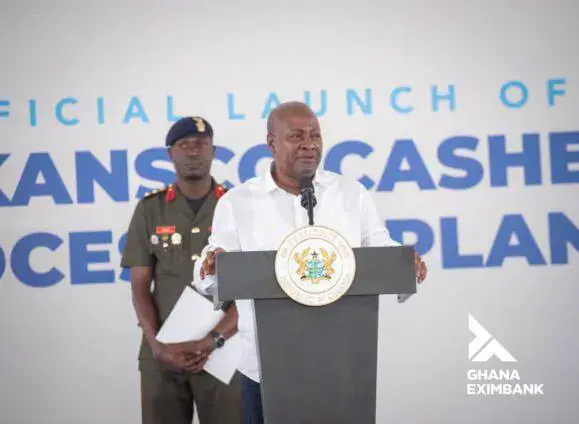
President John Dramani Mahama has unveiled plans to restrict the exportation of raw cashew nuts during the first three months of every harvesting season. This move aims to guarantee local manufacturers priority access to raw materials before exporters can transport surplus produce to international markets. The proposed interventions were announced during the commissioning of the Nadkansco Cashew Processing Limited factory in Techiman, Bono East Region.
The seasonal restriction will prevent foreign buyers from exhausting available supplies before Ghanaian processing companies secure sufficient quantities to sustain their operations. Ghana will adopt aspects of Côte d'Ivoire's approach, which has implemented interventions to encourage domestic processing and retain greater value from its agricultural exports. The restriction will operate during the initial three months of each harvesting season, after which exporters can purchase and transport remaining quantities.
In addition to the seasonal restriction, a levy on raw cashew exports will be introduced, with proceeds channelled into a dedicated fund to provide financial support to local processing companies. This financing mechanism will reinvest revenue generated from unprocessed cashew exports into expanding the country's domestic processing capacity. The government aims to address the significant imbalance between Ghana's cashew production volumes and its ability to process the commodity locally.
According to the Chief Executive Officer of Ghana Export-Import Bank, Sylvester Adinam Mensah, Ghana produced over 262,000 metric tonnes of raw cashew nuts in 2025 but processed only approximately 17,000 metric tonnes domestically. The majority was exported in its unprocessed form, leaving countries with more advanced processing industries to undertake subsequent manufacturing activities and capture additional economic benefits.
The newly commissioned Nadkansco facility, supported by approximately $12 million in financing from Ghana EXIM Bank, has an installed annual processing capacity of approximately 33,000 metric tonnes. The facility is expected to manufacture cashew kernels, cashew nut shell liquid, and briquettes for export markets, while also supplying processed products to the domestic market. It has generated nearly 1,000 direct employment opportunities and supports around 3,000 additional livelihoods.
President Mahama indicated that the facility could eventually employ up to 1,500 people, providing opportunities for young people in the Bono East Region and surrounding agricultural communities. However, he acknowledged that establishing processing infrastructure alone would not resolve the industry's challenges, particularly securing sufficient working capital to purchase and preserve raw materials throughout the year.
The President estimated that Ghana would require at least four or five additional factories of comparable capacity to significantly expand its ability to process the country's annual output. Achieving this objective will require sustainable financing, reliable electricity, modern processing equipment, efficient transportation networks, competitive pricing, and consistent supplies from farmers. The proposed export levy requires further clarification on its rate, administration, implementation date, and disbursement criteria.
Key points
- The Ghanaian government aims to restrict raw cashew exports and introduce a levy to support the local processing industry.
- The proposed interventions aim to guarantee local manufacturers priority access to raw materials and retain more economic value from the country's agricultural production.
- The country's annual cashew production of approximately 262,000 tonnes demonstrates the scale of investment required to establish a comprehensive domestic processing industry.