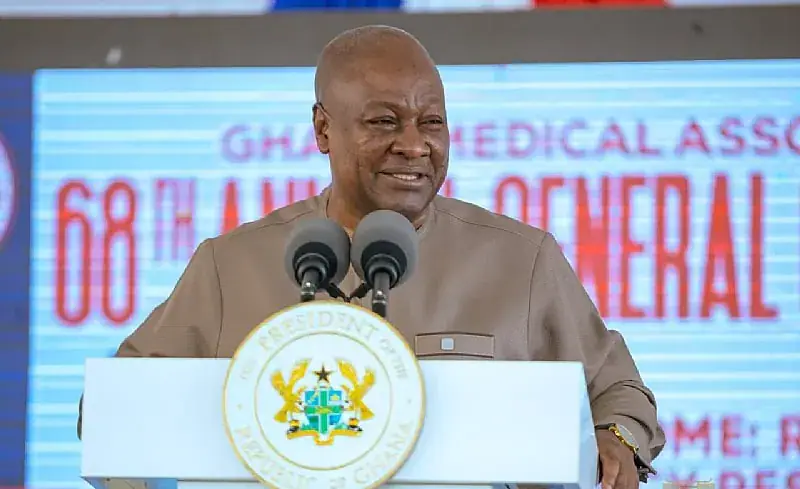
President John Dramani Mahama has announced that Ghana will transition out of the Gavi vaccine support programme and fully finance its vaccine procurement by 2030. Speaking at the Ghana Medical Association's Annual National Conference, he stated that the country currently finances approximately 50 per cent of its vaccine requirements. This move is part of the government's efforts to strengthen domestic financing for immunisation and other health programmes. The conference was held under the theme, "The No Bed Syndrome: Reimagining a Befitting Emergency Response System for Ghana".
President Mahama noted that the 2026 Budget has made provisions for vaccines, essential medical commodities, and other priority health programmes. He assured that the government will continue to strengthen domestic financing for immunisation, HIV and AIDS care, tuberculosis, and malaria services, as well as disease surveillance and laboratory capacity. The President acknowledged the contributions of development partners, including the World Health Organisation, UNICEF, Gavi, and the Global Fund, towards sustaining Ghana's health programmes.
The President also stressed the need to address environmental and other factors that contribute to ill health. He commended the Ghana Medical Association for its work on antimicrobial resistance and the health consequences of pollution, illegal mining, and lead exposure. President Mahama assured the medical profession that the government would continue to rely on its research, evidence, and professional recommendations in shaping health policies.
Primary healthcare, oral health, and mental healthcare will remain important components of the government's efforts to improve disease prevention and early treatment. As part of the oral healthcare initiative, the government is considering deploying mobile clinics equipped with dental facilities to extend services to underserved communities. President Mahama said dentists will be deployed to move from community to community to provide dental services and attend to the oral health needs of the people.
On emergency healthcare, President Mahama announced plans to procure 100 new ambulances to strengthen the fleet of the National Ambulance Service. He disclosed that the Service had indicated that another 100 ambulances currently out of operation could be restored if the necessary spare parts were provided. The government will purchase 100 new ambulances and procure the parts required to bring another 100 ambulances back into service.
President Mahama also revealed that the government will soon conduct a feasibility study into the sewage systems of major public health facilities across the country. The exercise will identify necessary repairs and help prevent medical waste and effluents from being discharged into drains and water bodies, posing risks to public health and the environment. This move aims to improve the overall healthcare infrastructure in Ghana.
The government's efforts to expand specialised healthcare will go hand in hand with sustaining essential public health services required by communities across the country. President Mahama reiterated the government's commitment to improving healthcare services and addressing the health needs of the population. The President's announcement on Ghana's exit from the Gavi vaccine programme by 2030 marks a significant step towards self-sufficiency in vaccine procurement.
Key points
- Ghana to fully fund its vaccine procurement by 2030
- President Mahama announces plans to deploy mobile clinics for oral healthcare
- Government to conduct feasibility study on sewage systems of public health facilities