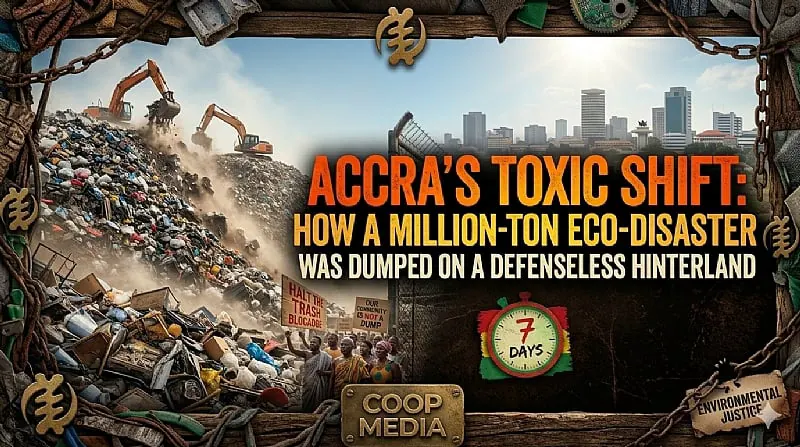
The Ghanaian government's initiative to clear Accra's Agbogbloshie waste site, a notorious environmental hazard, has triggered a crisis in the Nsawam-Adoagyiri Municipality. The site, which has stood for decades as a symbol of international environmental degradation, is being evacuated as part of a 90-day decommissioning scheme commissioned by President Mahama to prevent flooding and renew the urban area. However, the relocation of one million tonnes of waste to the Adipa landfill site has sparked outrage among local residents and officials.
The relocation exercise, which involves transporting hundreds of heavy truckloads of waste per night, has been carried out without formal consultation with the Nsawam-Adoagyiri Municipal Assembly, local traditional leaders, or the affected population. This omission has subverted national decentralization policies, rendering local governance structurally obsolete. The Ministry of Local Government, Decentralization, and Rural Development has apologized for the disruptions caused and defended the aggressive timeline, citing the need for 150 to 200 truck trips every night to complete the evacuation exercise.
The operational reality on the ground remains dire, with the local community engulfed by overwhelming odors and massive housefly infestations that have disrupted local schools and daily life. Former Accra Mayor Mohammed Nii Adjei Sowah has warned that the generation of hazardous leachate poses a severe risk of contaminating local groundwater tables during heavy rainfall, turning a temporary sanitation drive into a long-term public health crisis. The community has issued a seven-day ultimatum to block access roads, led by local Member of Parliament Hon. Frank Annoh-Dompreh.
To resolve the crisis, the discourse must shift away from partisan finger-pointing and focus on core breakdowns in institutional consultation, environmental engineering, and sustainable development. The Environmental Protection Agency (EPA) must independently test Adipa's water table and local streams for chemical and biological contaminants. The EPA must establish strict daily volumetric limits on incoming waste to ensure the site's structural containment thresholds are not overwhelmed.
A dedicated portion of the national sanitation budget must be legally funneled into Adipa to fund immediate healthcare upgrades, sustainable clean water infrastructure, and extensive rehabilitation of roads pulverized by nightly heavy truck traffic. The Ministry of Local Government must institutionalize a strict statutory requirement for written inter-district agreements, ensuring that no metropolitan area can export solid waste across regional boundaries without a joint oversight board, public hearings, and a formal sign-off from the receiving assembly.
The localized rebellion brewing in Nsawam-Adoagyiri is a symptom of a larger, systemic governance failure. Cleaning the clogged arteries of Accra to prevent seasonal urban flooding is an important objective, but doing so by suffocating a peri-urban community in the Eastern Region is an unacceptable trade-off. Ghana must outgrow the primitive practice of shifting its garbage from one backyard to another and treat waste management as a rigorous scientific and collaborative discipline.
The Ministry's official apologies and promises of a one-month operational wrap-up mean little to a community dealing with immediate ecological distress. The Greater Accra Region must prioritize and fast-track the construction of engineered recycling and waste-to-energy facilities inside its own regional borders, taking full structural responsibility for the waste its economy generates.
Key points
- The Ghanaian government must prioritize sustainable, transparent, and modern environmental standards to resolve the Adipa crisis.
- The relocation of waste to Adipa has sparked public health concerns and threats of a blockade in Nsawam-Adoagyiri.
- A dedicated budget must be allocated to fund immediate healthcare upgrades and infrastructure rehabilitation in Adipa.