Ghana's space ambitions, reignited by the 2017 launch of GhanaSat, a satellite developed by All Nations University, have yet to translate into tangible progress. The country's Cabinet approved the establishment of the Ghana Space Agency in 2025, but the agency still lacks a national law to make it operational. This absence of a legal framework hinders Ghana's ability to fully participate in the expanding space economy, valued at approximately $680 billion.
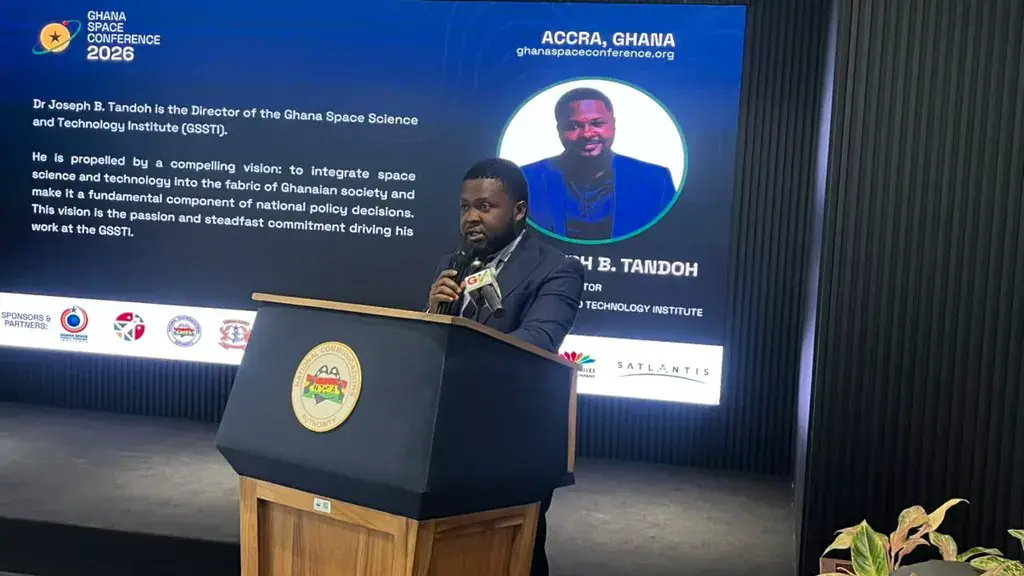
The Director of the Ghana Space Science and Technology Institute (GSSTI), Dr. Joseph Tandoh, has warned that Ghana risks missing out on its share of the global space economy unless Parliament passes a national space law. Dr. Tandoh, speaking at the 2026 Ghana Space Conference in Accra, emphasized that Cabinet approval alone does not enable the agency to formally come into being. He cited the absence of a legal framework as a major obstacle to regulating space-related incidents and managing liabilities.
Ghana has developed a national space policy, approved by Cabinet in 2022 and unveiled in 2024. However, without a law backing the agency, the country lacks the legal footing to regulate space activities carried out by universities, private companies, and start-ups. Dr. Tandoh pointed out that Ghana has signed international instruments, including the Outer Space Treaty, but has not yet ratified them, leaving open questions about institutional responsibility in space-related incidents.
The global space economy, valued at roughly $680 billion, presents a significant opportunity for Ghana, strategically located along the Equator. Several companies have expressed interest in exploring spaceport development in Ghana, citing the country's potential for lower-cost rocket launches. However, the lack of clear laws and regulations remains a major obstacle to attracting investment.
Dr. Tandoh urged Members of Parliament and relevant ministries to support the proposed space bill, describing it as central to the country's development. He emphasized the need for Ghana to take ownership of its space ambitions, stating, "Nobody understands our problems better than we do, and we cannot always depend on foreign partners for satellite images."
The 2026 Ghana Space Conference, themed "From Vision to Action," marks a shift from defining Ghana's space ambitions to implementing them. The Director of Space Hubs Africa, Kwaku Sumah, noted that the conference aims to move beyond discussions and focus on practical steps to make Ghana a key player in Africa's space industry.
The passage of a national space law is crucial to unlocking Ghana's share of the global space economy. Experts stress that swift action is necessary to enable the Ghana Space Agency to operate effectively and for the country to capitalize on emerging opportunities in the space sector. The proposed law will provide a regulatory framework, ensuring Ghana's participation in the global space economy is secure and sustainable.
Key points
- Ghana's space agency lacks a national law to operate despite Cabinet approval.
- The country risks missing out on its share of the $680bn global space economy without a national space law.
- The proposed space bill is central to Ghana's development and will provide a regulatory framework for the space sector.