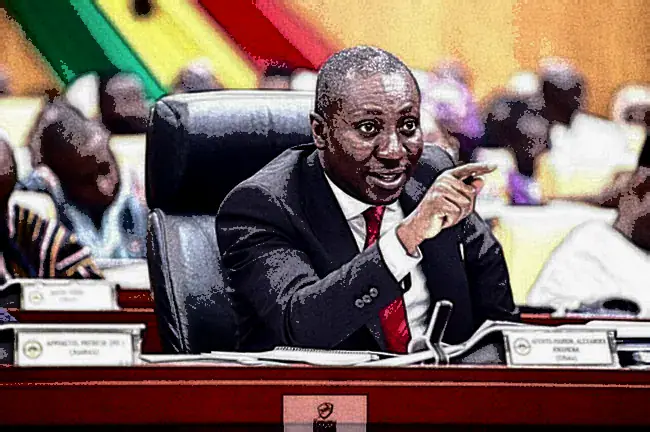
Alexander Afenyo-Markin, the Minority Leader and Member of Parliament for Effutu, claimed in an interview with German broadcaster DW on October 30, 2026, that the New Patriotic Party (NPP) introduced every single social intervention programme in Ghana since 1993. He cited examples such as the Free SHS, free compulsory basic education, and the National Health Insurance Programme. However, GhanaFact's investigation found that this claim is not accurate.
GhanaFact's checks revealed that successive governments under both the National Democratic Congress (NDC) and the New Patriotic Party (NPP) have introduced social intervention programmes to address various challenges in education, healthcare, poverty reduction, and employment. This indicates that social intervention programmes were not exclusively introduced by the NPP. The programmes have been a joint effort by both parties to improve the quality of life for Ghanaians.
Afenyo-Markin's claim that the NPP introduced Free SHS was also found to be misleading. Discussions and commitments to free secondary education in Ghana date back to 2008, when the NPP promised to introduce the policy ahead of the 2008 general elections. The National Democratic Congress (NDC) also announced plans to introduce free secondary education in 2014, during President John Dramani Mahama's State of the Nation Address.
President Mahama mentioned that the Ministry of Education had prepared a roadmap for the introduction of progressive free secondary education. The government subsequently made budgetary provisions in the 2016 Budget Statement to absorb selected fees for 320,488 day students in public senior high schools. This shows that the NPP was not the only party to introduce or plan for free secondary education.
A social intervention programme is an organised effort by governments, international partners, non-profit groups, or community organisations to solve specific social problems and improve the quality of life for individuals or communities. Examples of social intervention programmes in Ghana include the National Health Insurance Programme, free compulsory basic education, and the Free SHS policy.
The fact-check by GhanaFact found that the NPP and NDC have both played a role in introducing social intervention programmes in Ghana. The claim by Afenyo-Markin that the NPP exclusively introduced these programmes is therefore false. The fact-check also found that discussions on free secondary education predate the NPP's implementation of the Free SHS policy.
In conclusion, the claim by Alexander Afenyo-Markin that the NPP introduced every single social intervention programme in Ghana since 1993 is false. Both the NPP and NDC have contributed to the introduction of social intervention programmes in the country. The fact-check by GhanaFact highlights the importance of verifying claims to ensure accuracy and fairness in public discourse.
Key points
- The NPP did not exclusively introduce social intervention programmes in Ghana since 1993.
- Both the NPP and NDC have introduced social intervention programmes in Ghana.
- Discussions on free secondary education predate the NPP's implementation of the Free SHS policy.
Reporting sources
- FALSE: Afenyo-Markin claims NPP introduced every social intervention programme since 1993 · FactSpace West Africa