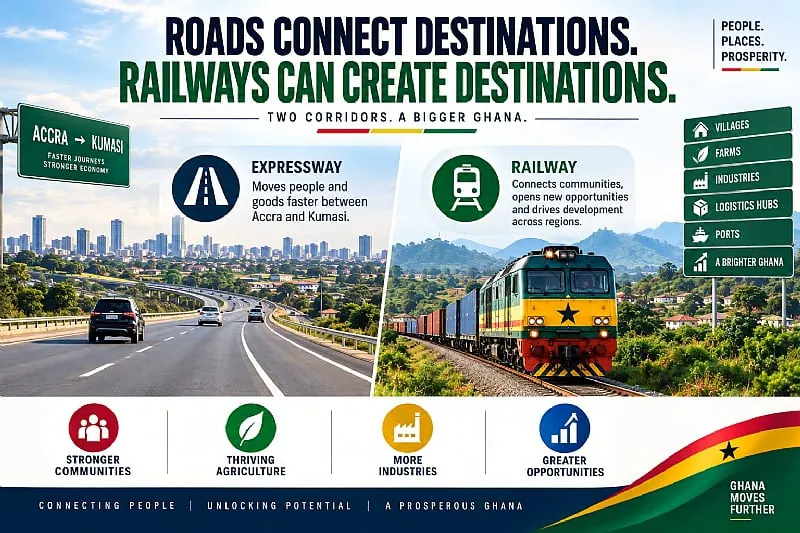
On September 14, 2026, President John Dramani Mahama presided over the handover of the cleared right-of-way for the Accra-Kumasi Expressway at Kwaso, near Ejisu in the Ashanti Region. The Ghana Armed Forces had cleared 175.6 kilometers of the corridor in 19 weeks, one week ahead of schedule. The expressway, spanning approximately 198.7 kilometers, aims to shorten the journey and reduce travel time between Accra and Kumasi.
The proposed expressway will feature about 176 kilometers of new six-lane expressway and roughly 23 kilometers of upgraded connector roads, linking Ablekuma in Greater Accra to Sewua in the Ashanti Region. This project is expected to considerably reduce travel time between Ghana's two largest economic centers. The existing Accra-Kumasi highway is approximately 270 kilometers. The government has also announced substantial domestic financing for the project.
During the ceremony, President Mahama disclosed that space had been reserved within the expressway corridor to accommodate a future railway between Accra and Kumasi. He also indicated that the Finance Minister would develop a financing plan for railway revitalization. This statement has sparked a national conversation about the strategic alignment of Ghana's future railway.
According to experts, a railway should not automatically follow a road simply because the road has already created a convenient corridor. The alignment of a railway should be determined by a combination of factors, including freight demand, population distribution, industrial potential, agricultural production, settlement patterns, future urban growth, and multimodal connectivity.
Ghana's existing Eastern Railway concept demonstrates a broader role by linking Accra, Kumasi, and Tema Port while supporting hinterland development and regional trade. A well-designed railway can stimulate new settlements, industrial clusters, agricultural markets, and inland logistics centers, thereby reducing excessive economic concentration in Accra and Kumasi.
Rather than automatically placing a future railway beside the new expressway, Ghana should undertake a comparative corridor study to identify the alignment that delivers the greatest long-term economic, social, and spatial benefits. This approach will ensure that the railway serves as a strategic tool for national development, opening new areas to trade, industry, investment, and opportunity.
The decision on the railway's alignment is crucial, as it will shape Ghana's national development for generations. Multimodal transport should be understood as integration rather than simple physical proximity. Railways, roads, ports, and inland waterways do not need to follow the same route; they need efficient interchange points, especially for connecting rail with Tema and Takoradi ports, Boankra, and the Volta Lake system.
Key points
- A strategic approach is needed to ensure Ghana's future railway serves as a tool for national development, opening new areas to trade, industry, investment, and opportunity.
- The alignment of the railway should be determined by a combination of factors, including freight demand, population distribution, industrial potential, agricultural production, settlement patterns, future urban growth, and multimodal connectivity.
- A comparative corridor study is necessary to identify the optimal alignment for the railway, delivering the greatest long-term economic, social, and spatial benefits.