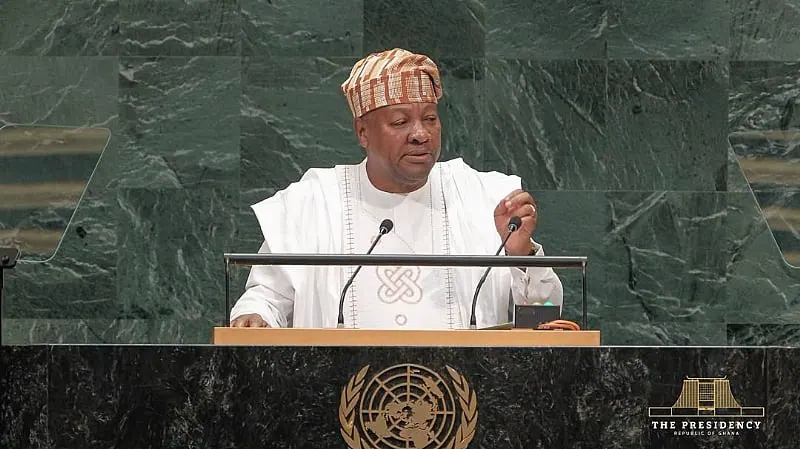
At the 81st United Nations General Assembly, Ghana's President John Dramani Mahama emphasized the need for Africa to take control of its natural resources and not be a passive arena for a new scramble for resources. He called for minerals to be processed at home, industries to be built on the continent, and more of the value from Africa's natural wealth to remain in Africa. This address highlights the critical issue of economic sovereignty and the need for Ghana to re-examine its approach to foreign capital.
Ghana has set an ambitious goal to end raw mineral ore exports by 2030, but this is only one sector-specific answer. The question of economic sovereignty goes beyond minerals and involves understanding who owns companies operating in the country, where their profits are declared, and whether taxes due are paid. The issue is not limited to mining, but also applies to agriculture, manufacturing, energy, construction, telecoms, finance, transport, tourism, and technology.
A significant challenge in tracking value creation is the use of special purpose vehicles (SPVs) and complex corporate structures. While SPVs can be used legitimately to ring-fence project risks or pool investment, they can also be used abusively to conceal ownership and shift profits. The public has reason to ask questions when ownership chains are opaque, related-party charges are not transparent, and legal residence is detached from economic activity.
The issue of illicit capital flight is a pressing concern for Ghana and the rest of Africa. According to the United Nations Conference on Trade and Development (UNCTAD), Africa's annual illicit capital flight was estimated to be $88.6 billion in 2020. This figure highlights the need for greater transparency and accountability in financial transactions. Double-taxation treaties should prevent income from being taxed twice, but they should not be used to escape taxation altogether.
The example of Patagonia's ownership structure, which prioritizes environmental causes, offers a useful lesson in how corporate ownership can be designed to recognize obligations to workers, communities, and the environment. Ghana can learn from this example and apply similar principles across its economy. Three key principles can guide Ghana's approach: requiring verified disclosure of company ownership, strengthening country-by-country reporting, and making local value creation measurable and enforceable.
To ensure that foreign capital contributes to Ghana's economic sovereignty, the government needs to put in place mechanisms to track value creation and ensure that profits are declared and taxed accordingly. This requires strengthening the capacity of the Ghana Revenue Authority to examine related-party transactions and challenge abusive pricing. The government also needs to establish public benchmarks, realistic timetables, and consequences for failure to meet commitments.
Ultimately, Ghana's quest for economic sovereignty requires a fair system that protects legitimate financing and insists that the law can follow the whole chain of value creation. This is not a choice between welcoming all capital and rejecting all foreign investment, but rather a choice between capital that builds productive capacity and structures that make ownership opaque while shifting the tax base out of sight. The harder test for President Mahama and his government is to implement these principles at home and ensure that Ghana can see, govern, and fairly tax the value its economy creates.
Key points
- Ghana aims to end raw mineral ore exports by 2030 as part of its bid for economic sovereignty.
- Africa's annual illicit capital flight was estimated to be $88.6 billion in 2020.
- Ghana needs to require verified disclosure of company ownership and strengthen country-by-country reporting to ensure economic sovereignty.