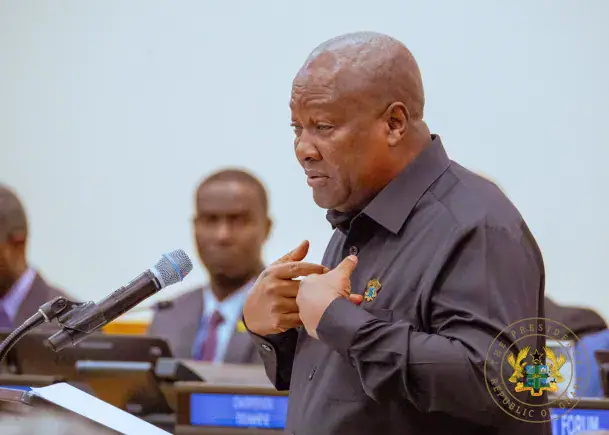
President John Dramani Mahama of Ghana has called for a formal apology and structured international dialogue on reparatory justice following UK Prime Minister Andy Burnham's acknowledgement of the Transatlantic Slave Trade. In a statement released on November 1, 2026, President Mahama welcomed the UK Prime Minister's statement as a bold and honest reckoning with the UK's legacy of slavery and colonialism. As the African Union Champion on Reparations and Chair of the Global Advisory Panel on Reparatory Justice, President Mahama emphasized the significance of this development.
The statement follows the landmark adoption of a Ghana-led UN Resolution declaring the transatlantic slave trade and racialised chattel enslavement as the gravest crime against humanity. President Mahama noted that Ghana, with the highest number of slave castles and forts in the world, speaks from a place of deep memory. The country is home to Cape Coast, Elmina, and Christiansborg, where millions were stripped of their humanity and shipped across the Atlantic. This historical context underscores Ghana's commitment to reparatory justice.
President Mahama stressed that a formal apology, although it cannot undo the profound injustices of the past, signals a crucial departure from past denial and opens the path toward genuine healing. He endorsed a structured, good-faith dialogue involving the African Union, CARICOM, the African diaspora, and countries that were part of the system of chattel enslavement. This dialogue aims to address the historical injustices and promote reparatory justice.
President Mahama outlined a five-point framework for the dialogue, encompassing a formal apology, a coordinated international commitment to dismantle systemic racism and Afrophobia, targeted investments in education, science, youth empowerment, climate resilience, and healthcare. The framework also includes the restitution of stolen cultural heritage and strategic development partnerships to address structural poverty and inequitable global economic architectures. This comprehensive approach seeks to address the multifaceted impacts of the Transatlantic Slave Trade.
The government commended Prime Minister Burnham and Foreign Secretary Ed Milliband for their moral leadership, stating that confronting historical truth is an act of statesmanship. The government emphasized that it has waited too long for this day and urged leaders to be remembered for their courage to confront the past honestly and seek healing and repair. This statement reflects Ghana's commitment to promoting accountability and justice.
President Mahama recognised that perspectives on reparatory justice may not be identical among partners, but emphasised that differences must not deter them from the shared objective. The government expressed appreciation for the UK's openness to a formal apology and its willingness to engage in a structured dialogue. This development is seen as a significant step toward addressing the historical injustices of the Transatlantic Slave Trade.
The President's statement concluded by highlighting the importance of international cooperation and collective action in promoting reparatory justice. The government's efforts aim to guarantee non-repetition of the dark chapter of human history and promote a more equitable future. Key stakeholders will engage in a structured dialogue to address the complex issues surrounding reparatory justice.
Key points
- President Mahama demands a formal apology and structured international dialogue on reparatory justice.
- Ghana leads UN Resolution declaring the transatlantic slave trade and racialised chattel enslavement as the gravest crime against humanity.
- President Mahama outlines a five-point framework for the dialogue on reparatory justice.