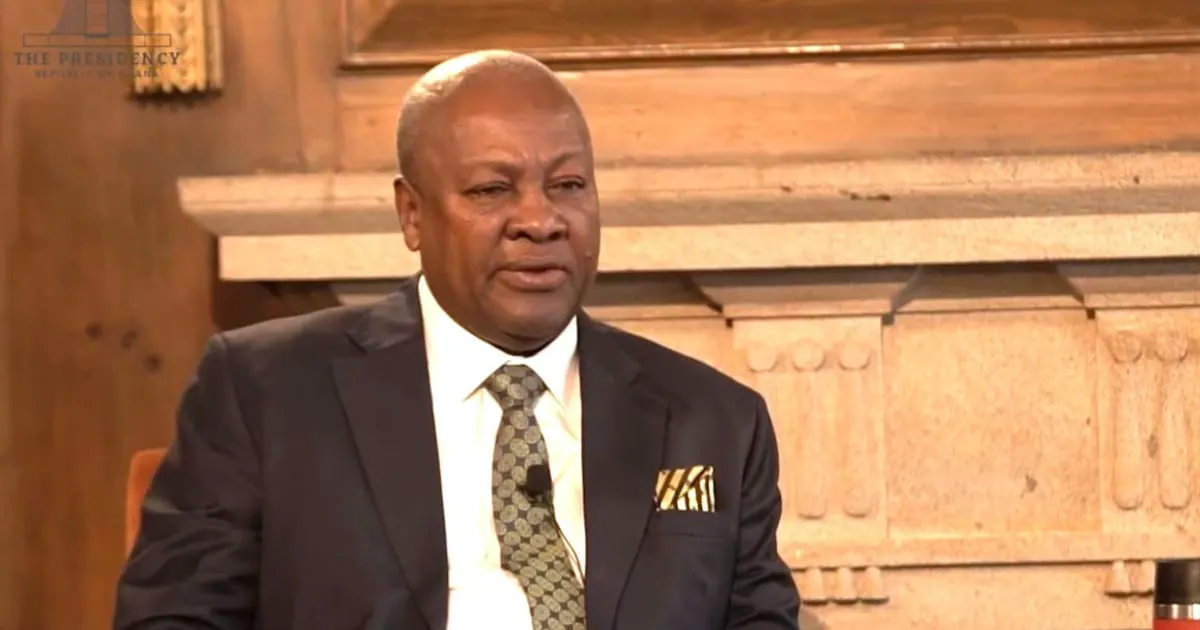
Ghanaian President John Dramani Mahama has defended his government's decision to reject a health compact offered by the United States, describing the attached conditions as humiliating and an affront to Ghana's sovereignty. The compact, valued at $100 million, aimed to support Ghana's health sector. However, President Mahama emphasized that Ghana would not compromise its sovereignty. The rejection was made during his presidency, although the exact date of the rejection is not specified.
According to President Mahama, the US health compact required Ghana to provide its pathogen profile and medical records, which he considered unacceptable. The pathogen profile would reveal diseases endemic to Ghana, while providing medical records would compromise the privacy of Ghanaian citizens. President Mahama expressed surprise at the demands, questioning who would provide another country's medical records.
President Mahama revealed that the Ministry of Health studied the compact and prepared a Cabinet Information Paper, which was subsequently presented to the Cabinet for consideration. The Cabinet flagged several concerns, including the requirement for Ghana to provide its pathogen profile and medical records. Additionally, the compact stipulated that Ghana's Food and Drug Administration would have no authority to inspect medications and medical products imported into the country.
The President emphasized that the conditions attached to the compact were humiliating and an affront to Ghana's sovereignty. He stated that the Cabinet rejected the compact in record time, opting instead to manage Ghana's health sector independently. President Mahama noted that Ghana was willing to forego the $100 million offer, choosing not to compromise its values.
President Mahama made these remarks during an engagement with the Council on Foreign Relations, a side event of the United Nations General Assembly. He highlighted Ghana's commitment to maintaining its sovereignty and democratic processes. The President's comments provide insight into the government's decision-making process regarding the US health compact.
The rejection of the US health compact reflects Ghana's determination to prioritize its national interests and values. President Mahama's comments suggest that Ghana is willing to explore alternative partnerships and funding opportunities that do not compromise its sovereignty. The incident highlights the complexities of international cooperation and the need for countries to carefully consider the terms of such agreements.
The incident has sparked discussions on the balance between international cooperation and national sovereignty. As countries navigate complex global relationships, they must weigh the benefits of partnerships against the potential risks to their autonomy. In Ghana's case, the rejection of the US health compact demonstrates the government's commitment to upholding its values and protecting its citizens' interests.
Key points
- Ghana's President John Dramani Mahama rejected a US health compact due to humiliating conditions.
- The compact required Ghana to provide its pathogen profile and medical records.
- Ghana prioritized its sovereignty and opted to manage its health sector independently.