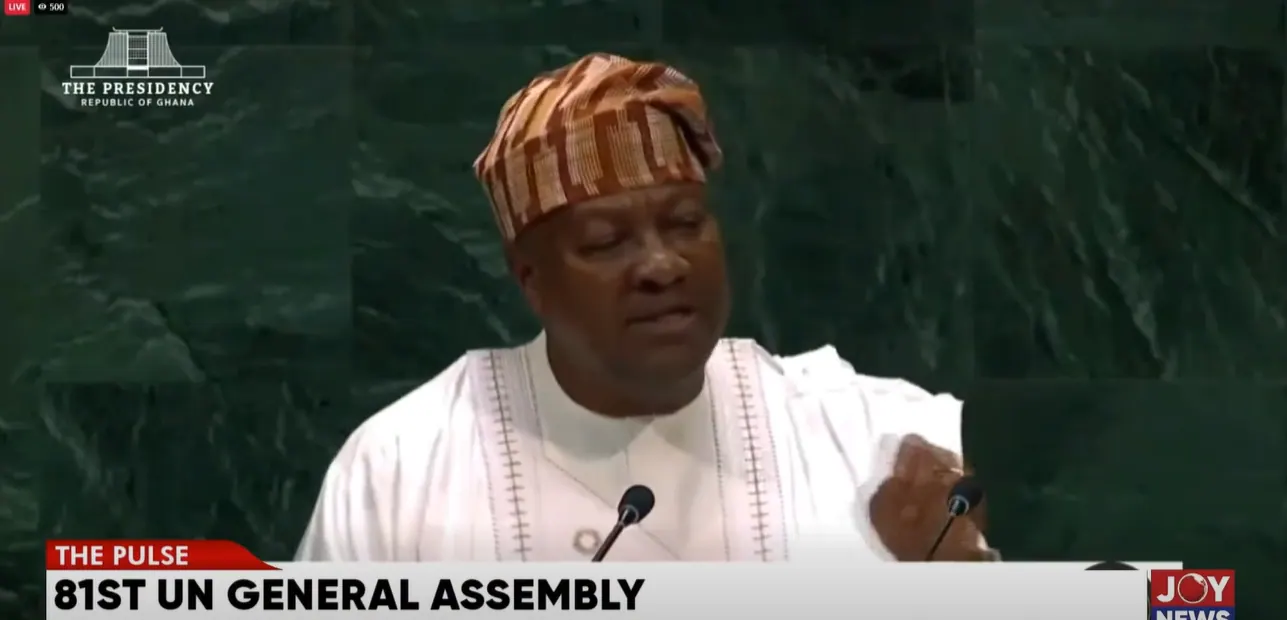
On September 24, 2026, Ghana's President John Dramani Mahama addressed the 81st Session of the United Nations General Assembly in New York. He congratulated the Assembly's President on his election and expressed confidence in his leadership. Mahama also commended outgoing UN Secretary-General António Guterres for his decade-long service to the world body. The Ghanaian President highlighted the significance of his country's national anthem, which inspires him to uphold the Pan-African and anti-colonial heritage.
President Mahama reintroduced himself to the General Assembly, sharing his personal background and cultural heritage. Born in Damongo, Ghana, he spoke of his parents and ancestors, as well as the various Ghanaian cultures he grew up with. He emphasized the importance of language in creating kinship and belonging. Mahama noted that every person in the Assembly has an origin and carries inherited memories, values, and identities that anchor them and provide dignity and pride.
However, Mahama warned that belonging can also have a dark side when weaponized by political expediency, leading to nativism, chauvinism, xenophobia, and prejudices against those deemed different. He stressed that the United Nations' founding principle remains immutable: every human being belongs to the human family, and no race is superior or inferior. The Ghanaian President emphasized that this moral foundation is essential for the UN to stand on.
Last year, President Mahama made a solemn pledge on behalf of Ghana, Africa, and the global African diaspora to secure international recognition of the transatlantic trafficking and racialized chattel enslavement of Africans as a crime against humanity. He noted that some cautioned against reopening old wounds, but Ghana's intention was to seek healing through truth, acknowledgement, and meaningful repair. Mahama emphasized that the transatlantic slave trade and chattel enslavement were not just historical events but have ongoing impacts on systemic racism and economic marginalization.
On March 25, 2026, Ghana tabled Resolution A/RES/80/250 in the UN General Assembly, which was voted in favor of by 123 nations. The resolution affirms that the transatlantic slave trade and chattel enslavement were the gravest crimes against humanity. Mahama thanked nations that voted for justice and expressed gratitude to partners across the Global South. He noted that the resolution was not a mere gesture but a necessary step towards addressing the structural legacies of historic crimes.
President Mahama welcomed positive overtures from countries and institutions to engage in dialogue on reparatory justice and restitution. The Netherlands, Germany, and France have made moves to join the conversation on reparatory justice. However, Mahama emphasized that real repair demands structural transformation, including dismantling unfair global trade regimes, predatory resource extraction, and discriminatory credit ratings. He stressed that Africa's economic development and global influence require meaningful change.
The Ghanaian President concluded his address by highlighting Africa's significant presence in the UN General Assembly, with 1.5 billion people and 18% of humanity, yet without a single permanent seat on the UN Security Council. He deemed this situation fundamentally unacceptable and called for reform. Mahama's speech emphasized the need for global recognition of the transatlantic slave trade as a crime against humanity and for structural transformation to address ongoing injustices.
Key points
- President Mahama calls for global recognition of transatlantic slave trade as crime against humanity
- Ghana tables resolution affirming transatlantic slave trade as gravest crime against humanity
- Mahama urges structural transformation to address ongoing injustices and reform of UN Security Council