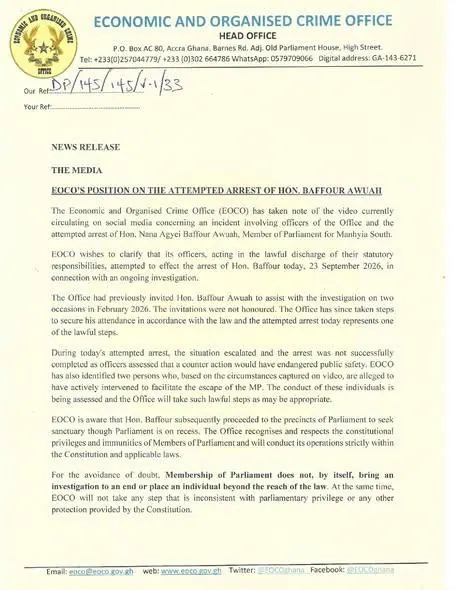
Ghana's Parliament has formally questioned the Economic and Organised Crime Office's (EOCO) decision to detain Manhyia South MP, Nana Agyei Baffour Awuah, after he voluntarily presented himself to its offices. According to reports, Baffour Awuah had not resisted or evaded the agency's process, sparking concerns over the rationale behind EOCO's actions. The case has drawn commentary from legal experts, civil society, and members of the governing party.
The standoff between EOCO and the Manhyia South MP dates back to February 2026, when the anti-graft agency first attempted to arrest Baffour Awuah. EOCO later issued a public statement defending its procedures, insisting it had acted within constitutional and legal frameworks and that it respects the privileges and immunities of Parliament. The case has since drawn sharp reactions from various stakeholders, including former NPP chairman Freddie Blay, who described the detention as 'bizarre' and 'comical'.
Civil society group, Democracy in Progress, has weighed in on the matter, calling for strict adherence to due process, judicial independence, and equality before the law in investigations and prosecutions involving politically exposed persons. The group's Legal Adviser, Andrew Appiah-Dankwa, emphasized that accountability efforts and due process are complementary rather than competing demands. This intervention frames the case as a test of EOCO's commitment to upholding the law.
Not all reactions have come from outside the governing NDC's circle. Lawyer Martin Kpebu, who is aligned with the NDC, has publicly expressed discomfort over the MP's treatment, stating that he did not campaign for the NDC to engage in what he called 'nonsense' in how EOCO has handled the case. This suggests that concerns over Baffour Awuah's detention extend into the ruling party's own support base.
The case has implications beyond the individual MP, with concerns that EOCO's practice of converting invitations into arrests could undermine its investigative work and erode public confidence in anti-corruption efforts. For ordinary Ghanaians, the case has become a litmus test of how anti-corruption bodies treat sitting MPs who cooperate voluntarily.
EOCO, Ghana's state agency mandated to investigate and prosecute serious financial and economic crimes, is now under scrutiny over its handling of the Baffour Awuah case. The standoff has generated significant media attention, with at least 20 articles across Ghanaian media outlets in under three months. The case has evolved into a broader test of immunity protections, due process standards, and EOCO's independence from political pressure.
Neither Parliament nor EOCO has announced a specific date for resolving the questions raised over the MP's detention. The sources reviewed do not indicate when or whether the agency will respond formally to Parliament's inquiry. The case remains a significant test of Ghana's anti-corruption efforts and the balance between accountability and due process.
Key points
- Parliament questions EOCO's detention of Manhyia South MP Baffour Awuah after voluntary surrender.
- Civil society group, Democracy in Progress, calls for due process in anti-graft cases involving politicians.
- The case has implications for Ghana's anti-corruption efforts and public confidence in EOCO's investigative work.