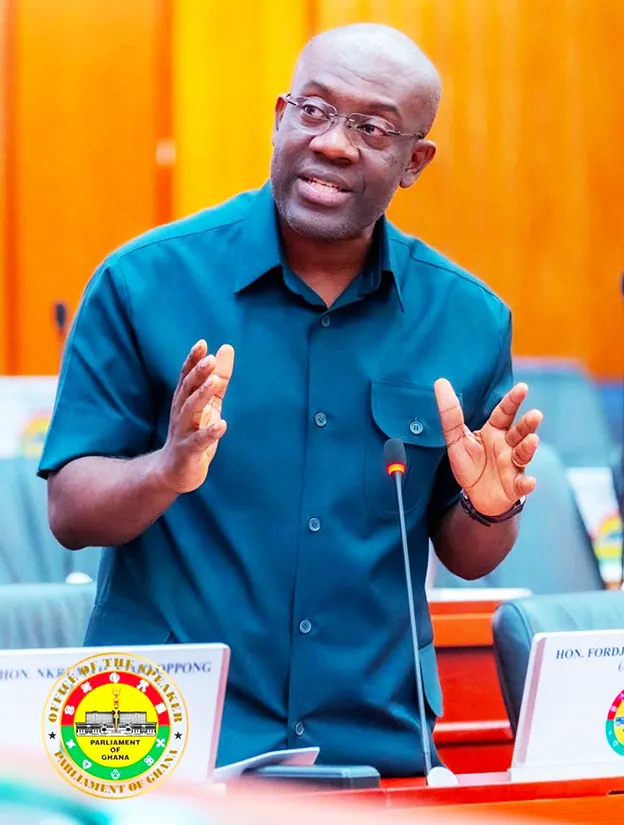
Ghana's opposition party has raised concerns over the government's unfulfilled economic promises, specifically questioning the creation of jobs under its 24-Hour Economy program. Kojo Oppong Nkrumah, the Member of Parliament for Ofoase-Ayirebi Constituency, has challenged the government to provide evidence, including SSNIT records, to prove that jobs have been created. The program, which aims to create 1.7 million decent jobs by the end of 2028, has been touted as a centerpiece of the National Democratic Congress' (NDC) economic plan.
Mr. Oppong Nkrumah expressed skepticism over the government's claims of job creation, citing 268 filling stations and 33 manufacturers operating in shifts as part of the program's achievements. He also questioned the 160,000 jobs expected from recently signed agreements, stating that without verifiable evidence, Ghanaians have no way of knowing whether those jobs exist. The opposition MP emphasized the need for transparency, calling for a verifiable register of jobs created under the 24-Hour Economy, including checks against payroll and SSNIT records.
The opposition MP also raised concerns about the implementation of the Women's Development Bank, which received significant budgetary allocations in 2025 and 2026. Despite this, the bank has yet to provide loans to women, with Mr. Oppong Nkrumah stating that market women are still borrowing from susu collectors and moneylenders at high interest rates. The bank was incorporated in January 2026 and is still awaiting a banking license.
Mr. Oppong Nkrumah further questioned the government's progress under the One Million Coders Programme, arguing that the number of people who have completed at least one module does not necessarily translate into trained coders or jobs. He also criticized the implementation of the Feed Ghana program and its poultry component, Nkoko Nkitinkiti, citing comments from the Agriculture Minister and the Poultry Farmers Association.
The opposition MP questioned the proposed scale of the New Economy, which commits about $10 billion over four years to commercial agriculture, mining value addition, energy, and transport infrastructure. He argued that several sectors identified under the new initiative are already covered by existing government programs. Mr. Oppong Nkrumah also rejected the government's suggestion that its policies are responsible for Ghana's recent macroeconomic improvements.
Mr. Oppong Nkrumah pointed to the IMF program secured in May 2023, the domestic debt exchange, and the June 2024 agreement with bilateral and commercial creditors as evidence of the previous administration's policies. He noted that inflation had declined from 54.1% at the end of 2022 to 23.8% by the time of the 2024 election, while the economy recorded 5.7% growth in 2024.
The opposition MP urged the government to suspend the rollout of the New Economy until it has properly accounted for earlier programs. He called for a firm date for the Women's Development Bank to commence lending, publication of its lending criteria, and data on One Million Coders graduates who have secured employment.
Key points
- The Ghanaian government is under pressure to provide evidence of job creation under its 24-Hour Economy program.
- The opposition has questioned the implementation of several government programs, including the Women's Development Bank and the One Million Coders Programme.
- The government has allocated significant funds to various programs, but their impact and effectiveness have been questioned by the opposition.