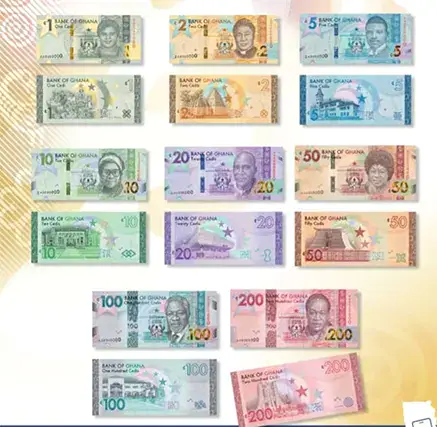
The Bank of Ghana has announced that the newly upgraded Ghana Heritage Series banknotes will enter circulation starting December 1, 2026. The new banknotes feature distinctive designs highlighting national heroes, historic sites, monuments, and Adinkra symbols to showcase the country's rich cultural heritage. According to Dr. Johnson Pandit Asiama, Governor of the Bank of Ghana, the new series was designed to celebrate Ghana's history and cultural identity while improving security, durability, and convenience in transactions.
The upgraded notes incorporate enhanced security features, improved durability, and smaller, more portable sizes to make them easier to handle and carry. Dr. Asiama stated that the introduction of the Heritage Series went beyond the issuance of upgraded banknotes, but was part of efforts to modernize currency management, preserve public confidence, and reflect the aspirations of generations of Ghanaians. The new series aims to reinforce the security of the Cedi, enhance convenience in everyday transactions, and instill a renewed sense of pride among Ghanaians in their national currency.
The Bank of Ghana developed an Enterprise Currency Operations Management Software, known as ECOMS, to improve coordination and operational efficiency in currency management. The Bank is also modernizing its currency processing centers and plans to establish additional cash centers at its regional offices in Ho and Tamale to ensure currency services are brought closer to the public. This move is expected to improve the overall efficiency of currency management and provide better services to the public.
As part of the launch, the Bank introduced the Cedi App, which is expected to educate the public on the security features of the Heritage Series and assist persons with visual impairments. The existing banknotes will continue to circulate alongside the new Heritage Series and will remain legal tender during the transition period. This arrangement is intended to give individuals and businesses sufficient time to adjust to the new notes without disrupting economic activities.
Dr. Asiama emphasized that cash remains an essential part of the country's monetary resilience, despite the growing adoption of electronic payment systems. He explained that technical failures, cyber incidents, and other disruptions could affect digital payment networks, making physical cash an important alternative for households and businesses. The Governor also revealed that the Bank is working with stakeholders on a new Currency Act to replace the Currency Act, 1964 (Act 242), which needs to be updated to reflect changes in the current financial and economic environment.
The proposed legislation will strengthen measures against counterfeiting, establish clearer procedures for detecting and destroying counterfeit notes, and provide legal backing to efforts to prevent the mutilation and abuse of banknotes. Dr. Asiama announced plans by the Bank to embark on a public education campaign across the regions and major local languages to enable people to become familiar with the new notes and their security features. He urged the public to handle the currency responsibly and take pride in the national heritage represented by the new series.
The launch event brought together several dignitaries, including the Ga Mantse, King Tackie Teiko Tsuru II, and the Agbogbomefia of the Asogli State, Togbe Afede XIV. The new Heritage Series banknotes are part of the Bank of Ghana's preparations to mark its 70th anniversary on March 4, 2027. The credibility of the national currency depends not only on sound monetary policies and effective institutions but also on the confidence of the people who use it.
Key points
- The new Heritage Series banknotes feature enhanced security features, improved durability, and smaller sizes to make them easier to handle and carry.
- The Bank of Ghana is working with stakeholders on a new Currency Act to replace the Currency Act, 1964 (Act 242).
- The existing banknotes will continue to circulate alongside the new Heritage Series and will remain legal tender during the transition period.