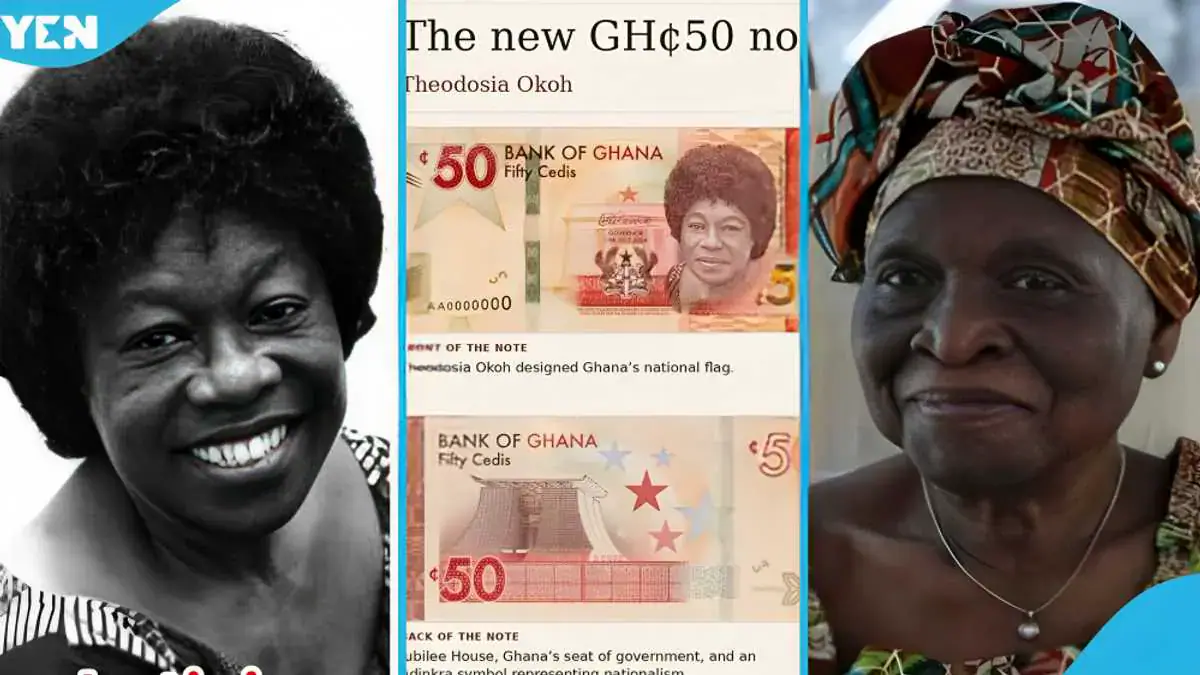
The unveiling of Ghana's new GHC50 banknote, featuring Theodosia Salome Okoh, has been marred by a family dispute over the portrait used. Dr Eddie Obeng, nephew of Theodosia Okoh, raised concerns that the image on the note bears a stronger resemblance to his mother, Dr Letitia Eva Obeng, than to Okoh. This claim has sparked a heated debate about the accuracy of the portrait.
Dr Letitia Eva Obeng was a renowned Ghanaian scientist who made significant contributions to the field of environmental research. Born on January 10, 1925, in Anum, Eastern Region, she attended Achimota College and later studied at the University of Birmingham in the UK, becoming the first Ghanaian woman to earn a Bachelor of Science degree in Zoology in 1952.
The Bank of Ghana has defended the portrait, stating that it was based on three verified photographs of Theodosia Okoh, with artistic adjustments made to meet banknote production and security standards. However, this explanation has not alleviated the concerns of Theodosia Okoh's family, who argue that the image used is not an accurate representation of their relative.
This is not the first time Dr Letitia Obeng has been mistaken for her sister. In 2020, a South African publication, The Continent, mistakenly published a photograph of Dr Obeng while identifying her as Theodosia Okoh. The publication later issued a correction, acknowledging that the two sisters had been misidentified in photographs published across various media.
Dr Letitia Eva Obeng had a distinguished career in science, serving as the first female science lecturer at Kwame Nkrumah University of Science and Technology, director of the Institute of Aquatic Biology, and leading the UNEP's Regional Office for Africa. She received numerous honors, including Ghana's Order of the Star of Ghana and honorary doctorates from KNUST and the Liverpool School of Tropical Medicine.
Dr Obeng passed away on March 23, 2023, at the age of 98, leaving behind a legacy in Ghanaian science. The dispute over the portrait has brought renewed attention to her remarkable career and contributions to environmental research. The Bank of Ghana's use of verified photographs aims to ensure the authenticity of the image, but the controversy highlights the importance of accuracy in representation.
Key points include the family dispute over the portrait on the new GHC50 banknote, Dr Letitia Eva Obeng's remarkable career in science and environmental research, and the Bank of Ghana's defense of the portrait based on verified photographs.
Key points
- The portrait on Ghana's new GHC50 banknote has sparked a family dispute, with some claiming it resembles Dr Letitia Obeng rather than Theodosia Okoh.
- Dr Letitia Eva Obeng was a renowned Ghanaian scientist who made significant contributions to environmental research.
- The Bank of Ghana has defended the portrait, stating it was based on verified photographs of Theodosia Okoh.