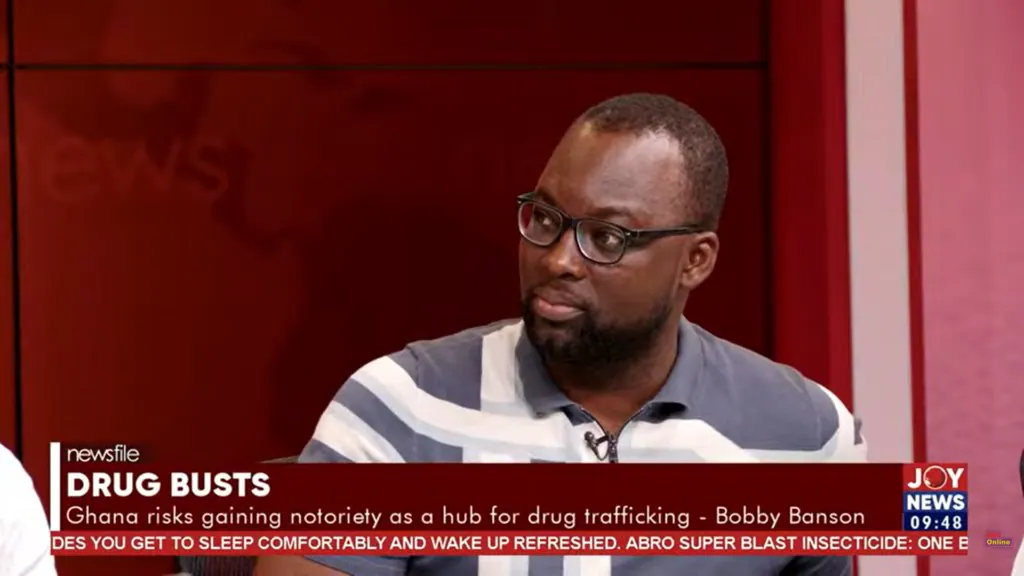
Ghana's narcotics enforcement architecture has been failing for years, with the country's primary agency, NACOC, admitting to being "more or less useless" due to institutional gaps. Deputy Director-General Elexander Twum-Barimah made this admission on JoyNews' Newsfile, revealing that the agency he inherited had significant shortcomings. Although he did not specify the gaps or detail corrective measures, this acknowledgment highlights the severity of Ghana's narcotics problem.
Lawyer and Ghana School of Law lecturer Bobby Banson warned that Ghana risks being branded internationally as a narcotics-trafficking hub unless urgent action is taken. He described reports that France does not trust Ghana enough to share drug-related intelligence as a "national embarrassment." This distrust damages the standing of ordinary Ghanaians abroad, regardless of the government in power. Banson pointed to his own travel experience, where passengers from certain countries face intensified screening, including sniffer dogs.
The issue gained attention after Assin South MP Rev. John Ntim Fordjour revealed that in April 2025, he had called for an investigation into two aircraft at Kotoka International Airport suspected of carrying cocaine or large sums of cash. Instead of an investigation, the government moved to arrest him. Fordjour's warning was previously challenged, but with France's seizure of nearly 3.9 tonnes of cocaine at the port of Dunkirk, reportedly concealed in a container shipped from Ghana, his concerns have been vindicated.
The France seizure has triggered weeks of scrutiny into Ghana's ports, airports, and maritime surveillance. Parliament was recalled for a special sitting on September 29 specifically due to pressure generated by the cocaine revelations. This move followed a public clash between an aide to Vice President Bawumia and the Maritime Authority over gaps in Ghana's sea surveillance.
In response to the crisis, NACOC has restricted entry to its port scanning room to Customs and Ghana Police Service Marine Unit officials only. This move aims to tighten access to sensitive areas and prevent similar incidents in the future. Separately, a suspect linked to the trafficking network was reported to have previously served in the presidential guard before quitting over a monthly salary of GH¢6,000.
The consequences of a damaged international reputation would fall on ordinary Ghanaian travellers, not just officials or politicians. If France's distrust over intelligence-sharing persists, or if Ghana's association with trafficking deepens, Ghanaians travelling abroad could face enhanced screening, including sniffer dogs at entry points. Banson appealed to political actors to avoid turning the crisis into a partisan issue.
The way forward remains uncertain, with no specified timeline for prosecutions connected to the Dunkirk seizure or institutional reforms at NACOC. Parliament's September 29 sitting, prompted by the cocaine pressure, remains the most concrete scheduled event tied to this unfolding story. The incident highlights the need for urgent action to address Ghana's narcotics problem and restore its international reputation.
Key points
- NACOC admits it was "more or less useless" due to institutional gaps.
- Ghana risks being branded internationally as a narcotics-trafficking hub.
- The consequences of a damaged international reputation would affect ordinary Ghanaian travellers.