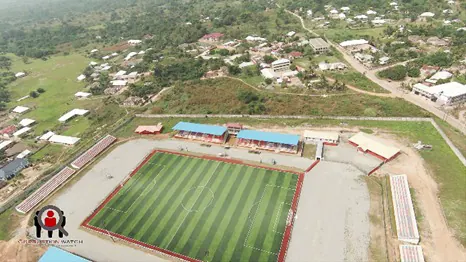
A recent investigation by Corruption Watch has uncovered a troubling pattern of corruption in Ghana's Astroturf program, including ownership disputes, procurement irregularities, privatization of stadium lands, abuse of office, and conflict of interest. The investigation found that former Minister of Energy, John Peter Amewu, and former Ghana Gas Communications Director, Ernest Owusu-Bempah, are at the center of the ownership dispute of sports facilities at Hohoe and Agogo, respectively. These facilities were constructed largely with public funds valued at more than GHS17 million.
The investigation focused on two key issues: ownership disputes and privatization of stadium lands for personal gain. These issues have already come under parliamentary scrutiny, with the Minister for Local Government, Chieftaincy and Religious Affairs, Ahmed Ibrahim, informing Parliament in June 2026 that his Ministry had become aware of a number of irregularities and breaches relating to the implementation of the Astroturf program. Ibrahim stated that projects were done by GNPC and given to private persons, and that this has resulted in revenue not going into the Ghana government coffers.
One of the sports facilities at the center of the controversy is the Hohoe Sports Stadium, which was constructed with substantial public resources. Corruption Watch investigations found that a total of GHS 8,195,000 was mobilized from at least five public institutions for the construction of the facility. The contractor, Wembley Sports Construction Limited, received payments from the Hohoe Municipal Assembly Development fund, the Ghana National Petroleum Corporation (GNPC Foundation), and the Ghana National Gas Company (Ghana Gas).
Despite the documentary record showing that the Hohoe Municipal Assembly initiated the project, acquired land for its development, and led the procurement process for its construction, former Minister of Energy, John Peter Amewu, maintains that the stadium was his personal initiative and not an Assembly project. Amewu stated that the stadium was built for the community and is not an Assembly project. However, the Municipal Chief Executive of the Hohoe Assembly, Prosper Kumi, said the Assembly has since been denied access to the facility, as well as the proceeds from revenue generated from the commercial use of the facility.
The Hohoe Municipal Assembly had awarded the contract for the construction of the stadium, but the contractor failed to officially hand over the facility to the Assembly during commissioning. The Assembly established a Stadium Review Committee to examine the circumstances surrounding the project and its management, but the Committee was denied access to the stadium. Corruption Watch investigators were also denied access during the course of this investigation.
Concerns over the management and ownership of the facility have intensified, with Amewu stating that the Assembly is not managing the stadium because of concerns about mismanagement. Amewu disclosed that a team of people are managing the stadium, and that he had to send GHS5,000 for the clearing of the place. The contractor, Wembley, confirmed that the stadium is in use but has not been handed over to the Assembly.
The issue has raised concerns about the use of public funds for private gain, and the need for parliamentary intervention to investigate and confiscate facilities being overtaken by individuals. Key issues to note include:
Key points
- The Hohoe Sports Stadium was constructed with public funds valued at GHS 8,195,000, but is being operated by private individuals.
- The facility has been denied to the Hohoe Municipal Assembly, which initiated the project and acquired land for its development.
- The ownership dispute and privatization of stadium lands have raised concerns about corruption and the use of public funds for private gain.