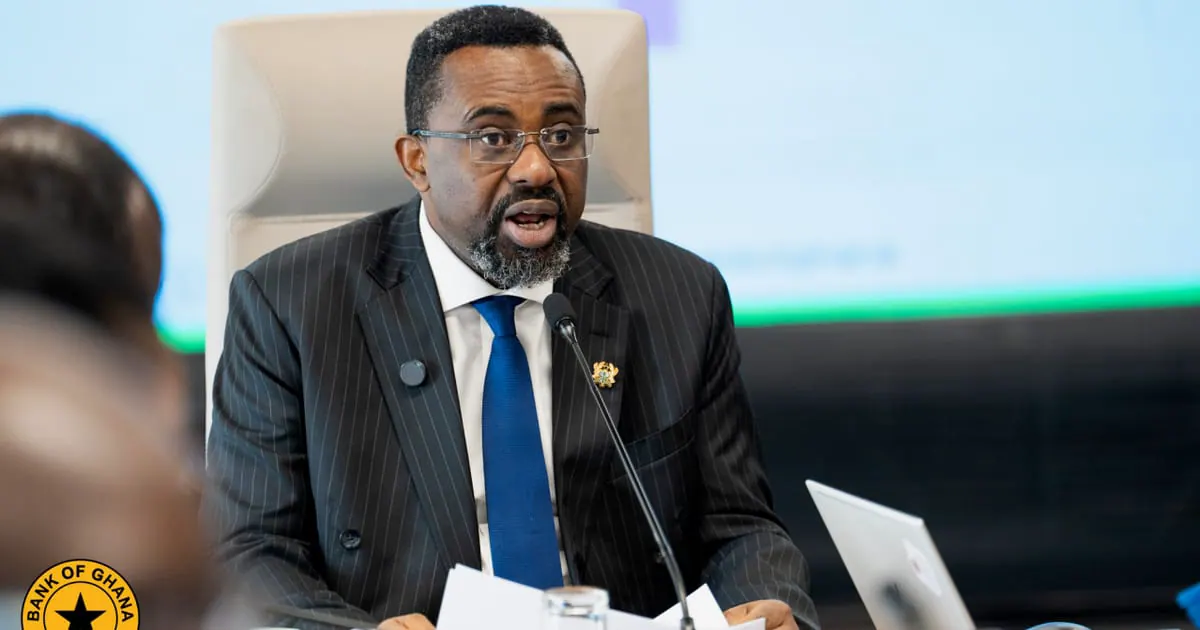
The Governor of the Bank of Ghana, Dr. Johnson Pandit Asiama, has emphasized the need for discipline in conducting monetary policy as the country prepares for the first International Monetary Fund (IMF) Policy Coordination Instrument (PCI) review in October. Speaking at the 132nd meeting of the Monetary Policy Committee (MPC) in Accra, Dr. Asiama stated that the IMF Board's decision in July brought the External Credit Facility (ECF) to a successful close and opened a new phase of engagement with the Fund through the PCI.
The PCI is a policy signalling instrument, and the markets will watch the behaviour of monetary and fiscal policy for credibility. Dr. Asiama told the MPC that the current policy rate of 14 percent must be assessed to determine if it remains the appropriate anchor for inflation expectations. The Committee will consider whether any adjustment is warranted, taking into account the balance of forces and analytical rigour.
Global economic developments continue to be dominated by the Middle East crisis, which has entered its seventh month. The conflict's trajectory has become highly uncertain, and risks to global growth and inflation have become more pronounced. Dr. Asiama noted that global growth forecasts have deteriorated considerably since the conflict began, with the World Bank and United Nations projecting global growth at 2.5 percent, well below pre-pandemic norms.
The global economic situation has significant implications for Ghana. Dr. Asiama indicated that the global shock is double-edged, with higher gold prices providing support for export earnings, reserve accumulation, and government revenue, while higher energy and fertiliser import costs could feed through quickly to transport, production costs, and consumer prices.
Despite the global challenges, domestic macroeconomic conditions in Ghana remain stable and broadly positive. Headline inflation, at 5.0 percent in August, is well below the lower bound of the 8±2 percent band. Real GDP grew by 6.0 percent in the second quarter, led by services and ICT, while private sector credit accelerated sharply.
The fiscal position is stronger than programmed, with a primary surplus above target, debt at 45 percent of GDP, upgrades from all three rating agencies, and debt distress risk reassessed from high to moderate. However, gross international reserves fell to US$11.07 billion, 4.2 months of import cover, and the current account is projected to record a deficit in the third quarter.
Dr. Asiama emphasized that rebuilding net foreign assets must remain the priority heading into the fourth quarter. The domestic position affords policy space, but the external position determines how much of it can safely be used. The MPC will continue to monitor the situation closely to ensure that the country's economic stability is maintained.
Key points
- The Bank of Ghana's Monetary Policy Committee must show discipline in conducting monetary policy as the country prepares for the first IMF PCI review in October.
- The global economic situation has significant implications for Ghana, with both positive and negative effects on the country's economy.
- Domestic macroeconomic conditions in Ghana remain stable and broadly positive, despite the global challenges.