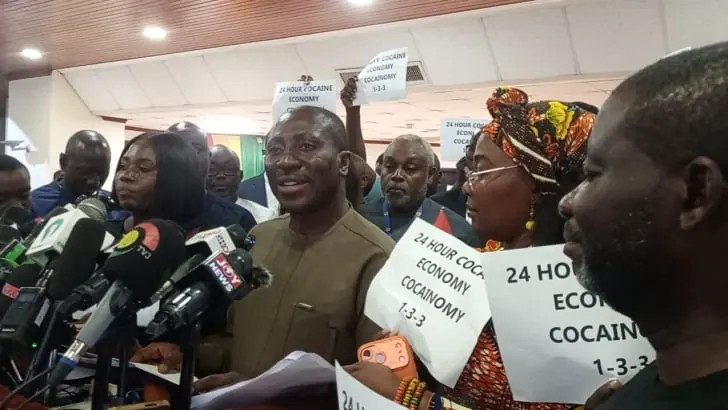
The Minority in Ghana's Parliament has announced its decision to pursue another constitutional and parliamentary route to investigate major narcotics consignments linked to the country. This move comes after Speaker Alban Bagbin rejected the proposed motion during an emergency sitting on September 29, 2026. Minority Leader Alexander Afenyo-Markin stated that the caucus would not allow the matter to end with the Speaker's ruling.
The Minority Leader emphasized that they would rely on the provisions of the 1992 Constitution and Parliament's Standing Orders to bring the issue back to the forefront. The caucus intends to use Parliament's oversight powers to examine the handling of major narcotics consignments and assess the performance of state institutions responsible for preventing Ghana from being used as a transit point for illegal drugs.
The original motion, filed by the First Deputy Minority Whip and Tolon MP, Habib Iddrisu, sought the formation of an Ad Hoc Committee to investigate the processes through which major narcotics consignments were handled, inspected, cleared, and exported from Ghana. The motion cited several incidents, including the seizure of 3.9 metric tonnes of cocaine by French Customs at Dunkirk on September 10, 2026.
The motion also referenced the seizure of 320 kilogrammes of methamphetamine by the Australian Border Force in June 2026, as well as earlier cocaine interceptions in Takoradi and Pedu in Cape Coast. These incidents have raised concerns about Ghana's role in the transshipment of narcotics.
Speaker Bagbin rejected the motion on the grounds that the proposed parliamentary investigation substantially overlapped with matters currently before the courts and could prejudice ongoing judicial proceedings. However, the Minority maintains that its proposed inquiry was not intended to determine the criminal liability of any accused person.
According to the Minority, the focus of the inquiry was on the performance, administration, and accountability of public institutions involved in narcotics control and related activities. The caucus questioned the Speaker's interpretation and application of Parliament's Standing Orders in dismissing the motion, arguing that all public institutions must operate within the confines of the law.
The Minority has vowed to exercise another option within the Constitution and Parliament's Standing Orders to ensure that the narcotics issue is brought back to the fore. The caucus aims to hold state institutions accountable for their role in preventing Ghana from being used as a transit point for illegal drugs.
Key points
- The Minority in Parliament will explore another constitutional option to investigate major narcotics consignments linked to Ghana.
- The Speaker of Parliament, Alban Bagbin, rejected the motion citing potential overlap with ongoing judicial proceedings.
- The Minority's proposed inquiry focused on the performance and accountability of public institutions involved in narcotics control.