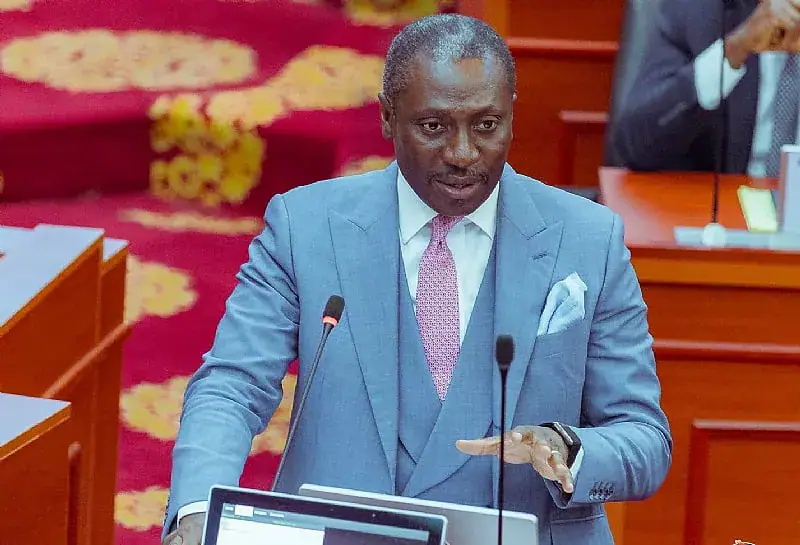
Ghana's Minority Leader, Osahen Alexander Afenyo-Markin, has expressed concerns over the Economic and Organised Crime Office's (EOCO) handling of frozen bank accounts, accusing the agency of unlawfully transferring customers' funds into its own accounts. He made these allegations during his concluding remarks on the 2027 Budget debate in Parliament on Thursday, November 26. Afenyo-Markin argued that EOCO and the Financial Intelligence Centre (FIC) were acting contrary to Article 296 of the 1992 Constitution, which regulates the exercise of discretionary powers by public authorities.
Afenyo-Markin questioned the justification for EOCO seeking court approval to transfer funds from frozen accounts into accounts controlled by the agency while investigations remained inconclusive and no charges had been brought against the affected account holders. He demanded to know the reasons for such transfers and the benefits they served. The Minority Leader also challenged commercial banks that allegedly transfer customers' frozen deposits to EOCO solely on the agency's instructions without obtaining court orders.
The Effutu MP warned that the practice could undermine businesses, cost jobs, discourage investment, and expose the country to judgment debts. He cited the case of Manhyia South MP Nana Agyei Baffour Awuah, who was arrested by EOCO without sufficient justification and demanded financial records covering a 10-year period. Baffour Awuah pleaded not guilty before the Accra High Court on October 3 to charges involving money laundering and causing financial loss.
Afenyo-Markin welcomed a directive by Attorney-General Dr. Dominic Ayine cautioning law enforcement agencies against improper arrest and detention practices. However, he accused the Attorney-General of having previously made public comments that could also be considered prejudicial. As of Thursday night, EOCO had not published any response to the allegations raised by the Minority Leader in Parliament.
Responding on behalf of the government, Majority Leader James Agalga rejected claims of state-sponsored harassment and challenged Afenyo-Markin to seek legal redress if he believed the agency had breached the law. Agalga described EOCO's initial attempt to arrest Baffour Awuah in September as “unprofessional” and insisted that the government would not tolerate the victimisation of individuals by state institutions.
Afenyo-Markin also used his concluding remarks to challenge the government's presentation of the country's economic performance, arguing that improvements in official statistics had not translated into meaningful relief for ordinary Ghanaians. He contrasted the government's macroeconomic achievements with the financial pressures facing households and businesses, insisting that economic progress must be measured by its impact on people's everyday lives.
The Minority Leader criticised the reduction in cocoa producer prices announced in February, delays in posting recruited teachers and nurses, and what he described as a shift in the government's policy messaging from the 24-Hour Economy programme to the New Economy agenda. Majority Leader Agalga defended the government's economic programme, describing the November 12 Budget Statement as a practical policy document focused on the needs of ordinary citizens rather than political slogans.
Key points
- EOCO's transfer of funds from frozen accounts into its own accounts raises concerns over potential constitutional violations and impacts on businesses and investments.