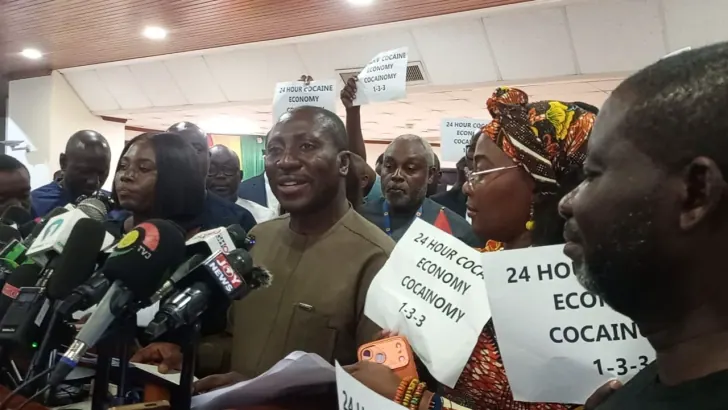
Ghana's Minority Leader, Alexander Afenyo-Markin, has expressed disappointment with Speaker Alban Bagbin's decision to dismiss a Private Member's Motion seeking a parliamentary inquiry into a series of narcotics seizures linked to Ghana. The motion, sponsored by the Minority, aimed to investigate the administration and effectiveness of public institutions connected to the narcotics incidents. Afenyo-Markin described the development as "a sad day for democracy and parliamentary oversight".
According to Afenyo-Markin, the Speaker's ruling improperly curtailed Parliament's constitutional oversight powers. He argued that the Speaker erred in relying on pending court cases to prevent Parliament from investigating the administration and effectiveness of public institutions connected to the narcotics incidents. The Minority Leader accused the Majority Caucus of using its numbers, with the support of the Speaker, to weaken Parliament.
Afenyo-Markin emphasized that the Minority-sponsored motion did not seek to interfere with criminal proceedings or determine the guilt or innocence of accused persons. Rather, it aimed to examine whether state institutions had effectively discharged their responsibilities. He cited Articles 93(2) and 103 of the 1992 Constitution, which vest legislative and oversight powers in Parliament.
The Minority Leader further cited Article 103(3), which empowers parliamentary committees to investigate and enquire into the activities and administration of ministries, departments, and agencies. He also mentioned Article 103(6), which gives parliamentary committees the powers, rights, and privileges of the High Court for purposes including compelling witnesses to attend and examining them.
Afenyo-Markin explained that the proposed inquiry was intended to examine whether institutions responsible for narcotics control, customs administration, port and airport security, intelligence gathering, maritime surveillance, and border protection had discharged their duties effectively amid a succession of major narcotics incidents since January 2025. He acknowledged that the functions of the courts and Parliament were distinct.
The MP for Effutu challenged the interpretation of the subjudice rule the Speaker relied on in dismissing the motion. He argued that the existence of a pending court case should not automatically prevent Parliament from examining broader institutional issues. Afenyo-Markin suggested that the proposed committee could have been directed not to investigate the guilt or otherwise of accused persons.
Afenyo-Markin said the proposed inquiry could have focused on various institutional systems, including container scanning procedures, customs control, and intelligence sharing. He emphasized that such systems are not on trial and that the inquiry would have allowed Parliament to exercise its oversight mandate while respecting the authority of the courts.
Key points
- The Minority Leader, Alexander Afenyo-Markin, criticizes Speaker Alban Bagbin's dismissal of a motion seeking a parliamentary inquiry into narcotics seizures linked to Ghana.
- Afenyo-Markin argues that the Speaker's ruling improperly curtailed Parliament's constitutional oversight powers.
- The proposed inquiry aimed to examine the effectiveness of state institutions in discharging their responsibilities amid a succession of major narcotics incidents.