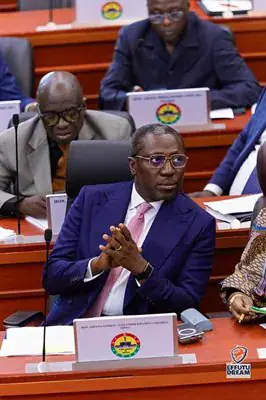
Ghana's Minority Leader Alexander Afenyo-Markin has expressed concerns over the government's decision to remove the collective portrait of the Big Six from the country's newly unveiled banknotes. The new notes, which were unveiled on November 10, 2026, feature only the portrait of Dr. Kwame Nkrumah. This change has been met with criticism from Afenyo-Markin, who described it as a troubling revision of Ghana's national history. The Big Six were a group of historical figures who played a significant role in Ghana's independence struggle.
The Big Six were not a creation of the New Patriotic Party (NPP), but rather historical figures whose recognition stemmed from their organised leadership in the independence struggle and their detention following the 1948 disturbances. Afenyo-Markin noted that the Convention People's Party (CPP) emerged from the United Gold Coast Convention (UGCC) in 1949, and argued that the contribution of the UGCC leaders cannot be separated from the independence story. He also referenced the Watson Commission and the Coussey constitutional process, which preceded the formation of the NPP and the National Democratic Congress (NDC).
Afenyo-Markin further cited Dr. Nkrumah's autobiography, in which Nkrumah referred to the group as "The 'Big Six', as we came to be known." The Minority Leader recalled that the Big Six appeared together on the redenominated banknotes introduced in 2007 under President John Agyekum Kufuor and Bank of Ghana Governor Paul Acquah, during Ghana's Golden Jubilee celebrations. This move was seen as a way to recognize the contributions of the Big Six to Ghana's independence.
The Minority Leader questioned why honouring additional patriots, such as Theodosia Salome Okoh, Ephraim Amu, and Kofi Annan, should necessitate the removal of the Big Six from the banknotes. He also called for broader national recognition for other historical figures, including Chief Simon Diedong Dombo, Otumfuo Sir Osei Agyeman Prempeh II, and Dr. J.B. Danquah, whom he credited with advancing the adoption of the name Ghana. Afenyo-Markin urged the government to consider the historical significance of the Big Six.
Afenyo-Markin also addressed the controversy surrounding the portrait of Mrs. Theodosia Salome Okoh, noting claims by her nephew, Dr. Eddie Obeng, that the image resembles his mother, Dr. Letitia Obeng, rather than his aunt. He urged the Bank of Ghana to publish the source photographs and resolve the matter transparently with the family. The Minority Leader emphasized the need for transparency in the selection of images for national currency.
The new banknotes were unveiled as Ghana prepares to commemorate its 70th Independence Anniversary. Afenyo-Markin concluded by urging President John Dramani Mahama to ensure that national recognition reflects the breadth of Ghana's history. He emphasized that the government cannot remove the Big Six from history, regardless of their decision regarding the banknotes.
The controversy surrounding the removal of the Big Six from the banknotes has sparked a national conversation about Ghana's history and the importance of recognizing its key figures. As the country prepares to celebrate its 70th Independence Anniversary, the debate is likely to continue. The government has yet to respond to Afenyo-Markin's criticisms.
Key points
- The Minority Leader criticizes the government's decision to remove the Big Six from Ghana's new banknotes.
- Afenyo-Markin argues that the Big Six were not a creation of the NPP, but rather historical figures whose recognition stemmed from their role in the independence struggle.
- The controversy has sparked a national conversation about Ghana's history and the importance of recognizing its key figures.
Reporting sources
- Minority leader criticises removal of Big Six from new banknotes · The Ghanaian Times