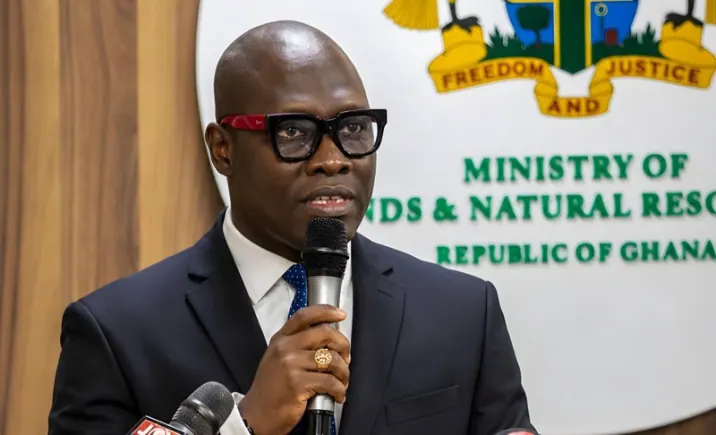
The Ministry of Lands and Natural Resources in Ghana has noted that some residents and local authorities in communities affected by illegal mining are shielding galamsey operators and warning them about impending arrests by the National Anti-Illegal Mining Operations Secretariat (NAIMOS). This development has made the fight against galamsey more challenging. According to the Media Relations Officer of the Ministry, Mr. Paa Kwesi Schandorf, some communities have become heavily dependent on illegal mining for income and employment.
Mr. Schandorf stated that some residents view illegal mining as a communal economic activity, making it difficult for NAIMOS to enforce the law. He cited the example of Osino, where an illegal mining site is located in the middle of the township, surrounded by settlers, food sellers, and shops. The site is operational, with residents appearing to support the mining activity. This has created a complex situation for authorities, who must balance enforcement with community engagement.
The Ministry has observed that some residents have protested against arrests carried out by NAIMOS, questioning why the government is enforcing the law against illegal miners. They argue that successive governments have failed to address unemployment needs, leaving them with no alternative sources of income. This sentiment is widespread in some communities, where residents feel that the government has not provided sufficient economic opportunities.
Mr. Schandorf recalled that the Minister of Lands and Natural Resources, Mr. Emmanuel Armah-Kofi Buah, had emphasized the need to engage with residents alongside enforcement measures. The situation in some mining communities has since shown the importance of this approach. Some residents appear to be coaching illegal miners and informing them when NAIMOS personnel are approaching, making it challenging for authorities to effectively enforce the law.
Despite these challenges, Mr. Schandorf noted that many local authorities have supported anti-galamsey operations, while several traditional authorities have provided strong support. NAIMOS is now permanently stationed in about 12 mining communities, with surveillance being carried out around the clock. The government plans to extend this permanent deployment to between 50 and 100 communities, based on intelligence assessments.
The impact of illegal mining is also evident in Ghana's forest reserves, with 44 of 288 reserves affected by galamsey. However, nine reserves that were taken over by armed illegal miners have been recovered by NAIMOS under the direction of Mr. Buah. While armed miners still attempt to re-enter some reserves, these attempts are being repelled. The government is working to prevent further incursions and protect the country's natural resources.
The government has also considered calls for a state of emergency over illegal mining but has determined that such a declaration is not necessary at this time. President John Dramani Mahama has indicated that the option would be considered if a security and threat assessment showed that it was necessary. For now, the government will continue working to produce results that can be independently verified, with a focus on engaging residents and enforcing the law in a sustainable way.
Key points
- Some residents in Ghanaian communities are shielding illegal miners and questioning government enforcement efforts.
- The government has recovered nine forest reserves that were taken over by armed illegal miners.
- NAIMOS will be permanently stationed in between 50 and 100 mining communities to combat galamsey.