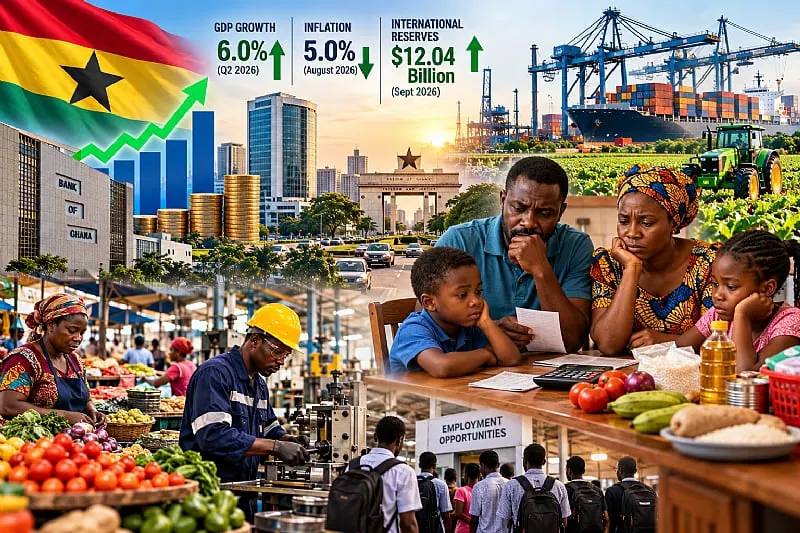
Ghana's economy appears to be turning a corner, with inflation falling sharply from its recent highs and economic growth strengthening. The country's macroeconomic stability has improved, with international reserves increasing and significant progress made in restoring economic stability. However, the question remains as to when this recovery will be felt by ordinary Ghanaians. For many households, economic recovery is measured by the price of basic necessities, job availability, and the cost of borrowing.
According to recent data, Ghana's real GDP expanded by 6 percent in the second quarter of 2026, driven by growth in services and information and communication technology. Headline inflation had fallen to about 5 percent by August, a significant improvement from the 54.1 percent peak recorded in late 2022. While these achievements are important, it is essential to note that lower inflation does not mean prices have returned to their previous levels, but rather that they are increasing more slowly.
The growth in GDP does not necessarily translate to improved household incomes, particularly if the benefits of growth are not evenly distributed. Ghana needs to focus on the quality and employment impact of growth, particularly for young people, who face high unemployment rates. Sectors such as agriculture, agro-processing, manufacturing, construction, tourism, and small-scale enterprises offer significant opportunities for job creation.
Credit remains a major challenge for many businesses and households, despite the Bank of Ghana's policy rate declining from crisis-era levels. Borrowing remains expensive, making it difficult for small manufacturers, farmers, and entrepreneurs to access affordable financing. Government borrowing also requires careful management to avoid competing with private businesses for available capital.
To convert financial stability into productive investment, Ghana needs to expand credit-guarantee programs and other risk-sharing arrangements to encourage lending to viable small and medium-sized enterprises, agriculture, manufacturing, and export-oriented businesses. Development finance should focus on enterprises capable of creating jobs and replacing imports.
Maintaining fiscal discipline is also crucial to avoid uncontrolled expenditure or the accumulation of new arrears. International reserves and a relatively stable currency provide a foundation for recovery, but Ghana cannot permanently defend its currency solely by accumulating reserves. The long-term solution lies in producing and exporting more while importing less of what the country can competitively manufacture itself.
Ultimately, ordinary citizens will judge the success of Ghana's economic recovery based on factors such as the cost of living, job availability, and access to affordable credit. The next challenge for Ghana is to move beyond stabilization and towards structural transformation, ensuring that the benefits of economic growth are felt by all, particularly at the kitchen table.
Key points
- Ghana's economic recovery is yet to be felt by ordinary citizens.
- The country needs to focus on job creation and affordable credit to support small businesses and households.
- Structural transformation is necessary to ensure sustainable economic growth and prosperity.