The current discussion on Ghana's economic performance has been sparked by Lawyer Kofi Bentil, who noted that every finance minister in Ghana claims to be a genius. The key question, according to Bentil, is what each minister met when they assumed office. This has led to a comparison of the economic conditions faced by the New Patriotic Party (NPP) and the National Democratic Congress (NDC) governments.
In 2017, the NPP government, led by Ken Ofori-Atta, inherited a struggling economy with a failed IMF programme. The NDC government had signed a $918 million Extended Credit Facility in April 2015, but by December 2016, virtually every target had been missed. The IMF reported that the overall fiscal deficit had deteriorated to an estimated 9 per cent of GDP, instead of declining to 5¼ per cent of GDP as envisaged under the IMF-supported programme.
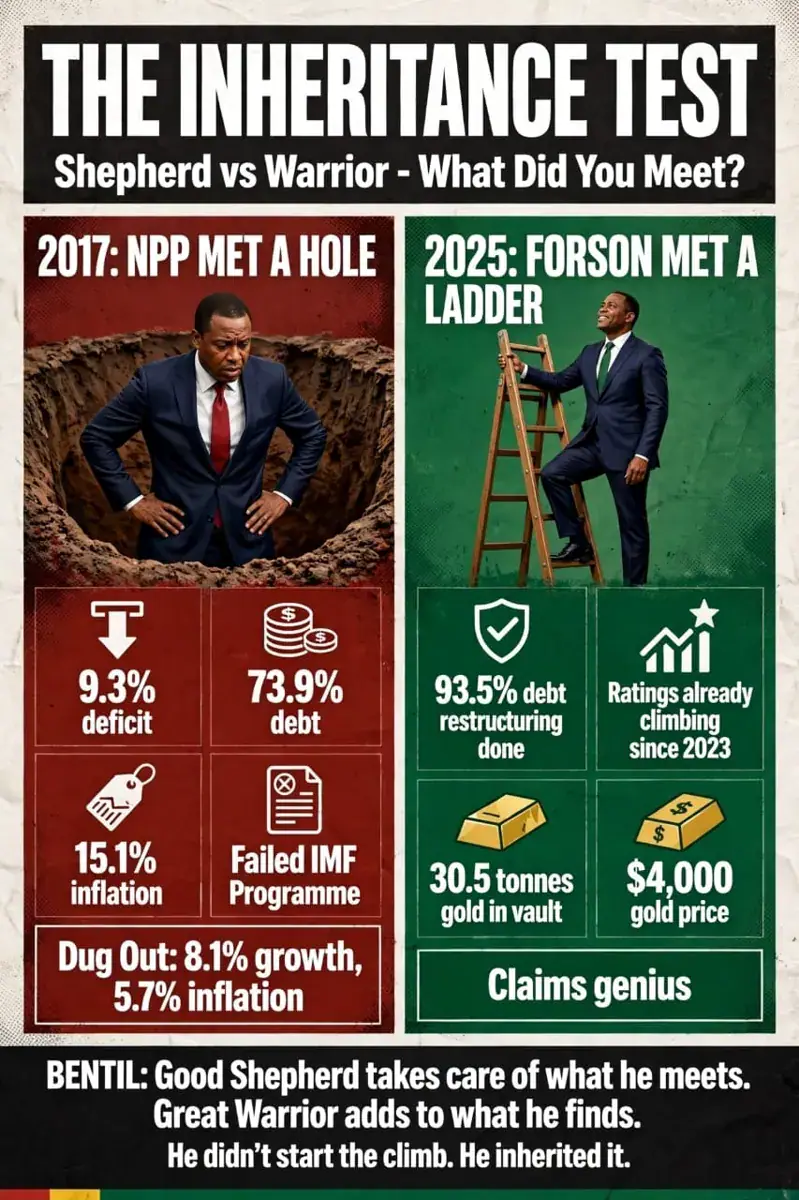
The NPP government faced significant challenges, including a 2016 fiscal deficit of 9.3% against a target of 5.3%, a debt-to-GDP ratio of 73.9%, and inflation at 15.1% against a target of 10.1%. Despite these challenges, the NPP government was able to deliver significant economic improvements, including GDP growth of 8.1% in 2017 and 6.2% in 2018. However, the government's economic progress was later undermined by the COVID-19 pandemic, the 2020 election spending, and the 2022 Russia/Ukraine war.
In contrast, the current NDC government, led by Ato Forson, inherited a much more stable economy in 2025. The government inherited an IMF programme that had already been signed in May 2023, with three reviews completed by the end of 2024. Additionally, 93.5% of Ghana's total public debt had already been restructured, including $20.4 billion domestic debt and $13.1 billion Eurobonds.
The NDC government also inherited a country with improving credit ratings. Fitch upgraded Ghana's Long-Term Local Currency rating from Restricted Default to CCC in March 2023, under the NPP government. Further upgrades were made in October 2024, after the government completed the Eurobond exchange. These upgrades were made under NPP Finance Minister Dr. Mohammed Amin Adam, not Ato Forson.
Despite these favourable conditions, the NDC government still faces significant economic challenges. All three major credit rating agencies - Fitch, S&P, and Moody's - still rate Ghana as speculative grade, or junk. These agencies have warned that interest payments will continue to eat into government revenue, and that the Bank of Ghana's financial position and the fiscal costs associated with the Ghana Gold Board require continued attention.
The Domestic Gold Purchase Programme, which was initiated in July 2021 under the NPP government, has also contributed to Ghana's economic stability. The programme has seen significant gold purchases, including 8.78 tonnes in May 2023. The programme's success has been inherited by the NDC government, which has benefited from the gold price rise.
Key points
- The NPP government faced significant economic challenges in 2017, but was able to deliver improvements before the challenges were later undermined by external factors.
- The NDC government inherited a much more stable economy in 2025, with an IMF programme already in place and significant debt restructuring completed.
- Despite favourable conditions, the NDC government still faces significant economic challenges, including a speculative-grade credit rating and high interest payments.