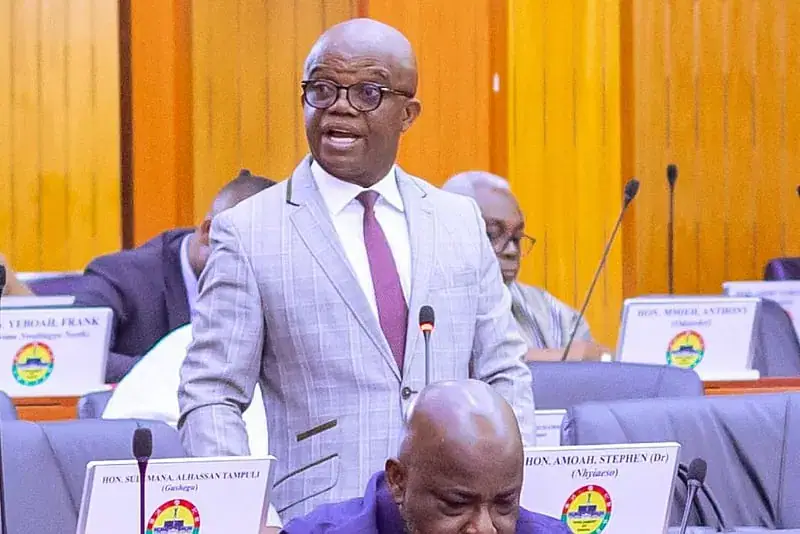
Dr Stephen Amoah, Deputy Ranking Member of Parliament's Finance Committee, has expressed concerns about Ghana's economic state, citing that improved macroeconomic indicators have not translated to better financial conditions for ordinary citizens. He made these remarks during the debate on the 2027 Budget in Parliament on November 18, 2026. Amoah emphasized that several sectors critical to economic activity and household welfare are underperforming.
Amoah pointed out that figures in the government's budget estimates reveal weaknesses in areas directly affecting Ghanaians' daily lives, despite progress in some macroeconomic indicators. He humorously illustrated his point by saying, "Even though the premier macro indicators are well, Mr Speaker, look at my pocket. See my pocket. There's no money." His comments came as lawmakers scrutinized the government's economic management and policy measures proposed in the 2027 Budget.
The Nhyiaeso MP also challenged criticisms of the previous New Patriotic Party (NPP) administration's economic record, particularly regarding the challenges Ghana faced in 2019 and 2020. Amoah argued that the economic difficulties during that period were largely shaped by extraordinary global circumstances that affected countries worldwide. He maintained that it is unfair to assess the administration's performance without considering the wider context.
According to Amoah, 2019 and 2020 were a phase in the history of the world that any honest person would accept as unprecedented. He stated that the global challenges of those years must be factored into any fair evaluation of the previous government's economic performance. Amoah's remarks highlight the ongoing debate about the state of Ghana's economy and the effectiveness of economic management.
The debate on Ghana's economy comes as lawmakers review the 2027 Budget, which outlines the government's policy measures and economic projections. Amoah's concerns about the underperformance of critical sectors and the impact on household welfare are likely to be key considerations in the budget discussions. The government's response to these concerns will be closely watched by citizens and stakeholders.
Dr Amoah's comments reflect a broader concern about the disconnect between macroeconomic indicators and the lived experiences of ordinary citizens. While Ghana's macroeconomic indicators may show improvement, the country's citizens may not be feeling the benefits. This disconnect can have significant implications for the government's economic policy and the well-being of Ghanaians.
The discussion around Ghana's economy is expected to continue, with lawmakers and stakeholders scrutinizing the government's economic management and policy measures. The 2027 Budget will play a critical role in shaping the country's economic trajectory, and the concerns raised by Dr Amoah are likely to be a key part of the conversation.
Key points
- Dr Stephen Amoah questions Ghana's economic state despite improved macro indicators.