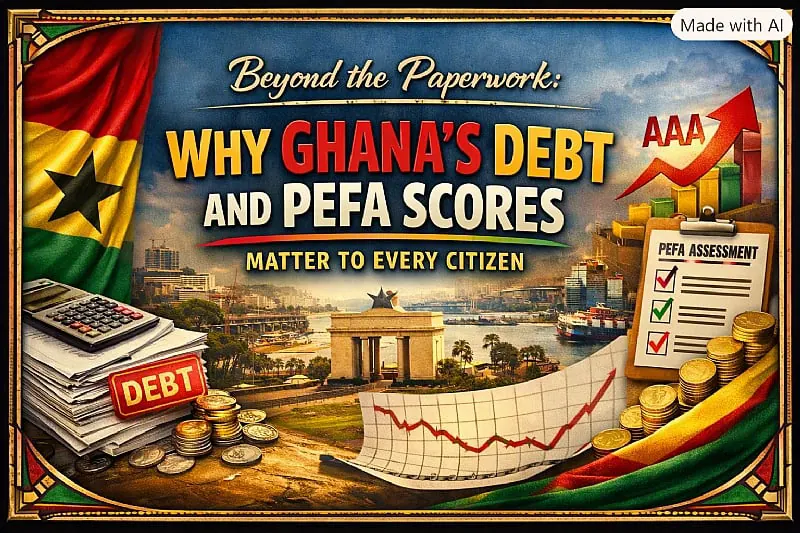
For decades, Ghanaian citizens have been anxious about economic headlines, from soaring inflation to international debt restructurings under IMF oversight. However, public finance is not abstract; it directly affects citizens' lives through uncompleted roads, erratic water supply, overstretched hospitals, and a rising cost of living. The engine of Ghana's economy is its Public Financial Management (PFM) system, which has an enviable legal architecture, including the Public Financial Management Act, 2016 (Act 921). Yet, global diagnostics like the Public Expenditure and Financial Accountability (PEFA) framework reveal a troubling reality: Ghana excels at drafting laws but struggles with enforcement.
Ghana's Public Debt Management is guided by Act 921, which established clear, legally binding guardrails to secure transparency and mandate strict oversight. The Annual Public Debt Report (APDR) requires the Ministry of Finance to provide comprehensive data on the national debt stock, borrowing strategies, and government-backed guarantees to Parliament and the public. The Strategic Anchor Rules bound the state to a long-term debt-to-GDP ceiling of 45% and an annual primary surplus target of at least 1.5%. An independent Fiscal Council and a specialized Compliance Division within the Ministry of Finance were also established to monitor compliance.
Despite these stringent legal provisions, the core problem remains a lack of enforcement. Off-budget spending, state-owned enterprise (SOE) liabilities, and costly contractual "take-or-pay" liabilities regularly bypass standard systems, contributing to significant debt accumulation. Prominent local think-tanks have repeatedly sounded the alarm, noting that Ghana's fiscal crises are born from behavioral failures rather than a lack of legal instruments. IMANI Africa's Fiscal Recklessness Index (FRI) pointed out massive financial irregularities often stemming from "off-system procurements that inflate costs by billions".
The Institute for Fiscal Studies (IFS) argues that addressing the symptom of debt is insufficient without tackling underlying drivers. The IFS highlights that long-term debt sustainability requires rigid adherence to fiscal anchors, forcing the state to fund critical services through aggressive domestic resource mobilization rather than perpetual deficit spending. The Centre for Policy Analysis (CEPA) emphasizes that structural macroeconomic stability cannot exist when statutory funds and expenditure projections are constantly sacrificed to accommodate political cycles.
The PEFA framework evaluates Ghana's actual performance against global standards, revealing systemic structural mismatches. Budget Reliability is scored C to D, with primary budgets frequently unreliable and a wide divergence between revenue projections and actual execution outturns. Debt Recording and Reporting is scored B to C, with external reviews highlighting systemic vulnerabilities, including massive reporting errors. The GIFMIS Bypass is scored C, with various ministries regularly bypassing the digital network, generating large, unbudgeted domestic expenditure arrears.
To transform Ghana's PFM system, the government must adopt targeted, uncompromising reforms. Enforcing absolute GIFMIS compliance is crucial, with automated hard stops within the public ledger to block unbudgeted commitments. Mandating monthly debt reconciliations will eliminate severe accounting errors and restore institutional credibility. Sanctioning procurement and oversight breaches is also essential, with Parliament and the judiciary aggressively enforcing punitive clauses within Act 921.
Think-tanks demand strict compliance and institutional autonomy to shield Ghana's resource legacy. The government must bridge the gap between legislative ideals and operational realities to secure a sustainable economic future. By implementing these reforms, Ghana can ensure that its PFM system operates effectively, and its economic growth is driven by productive infrastructure, not constrained by fiscal crises.
Key points
- Think-tanks urge Ghana to enforce strict compliance with its Public Financial Management Act to secure a sustainable economic future.
- Ghana's PEFA scores reveal systemic structural mismatches, including unreliable budget execution and debt recording errors.
- Reforms, including GIFMIS compliance and monthly debt reconciliations, are necessary to transform Ghana's PFM system.