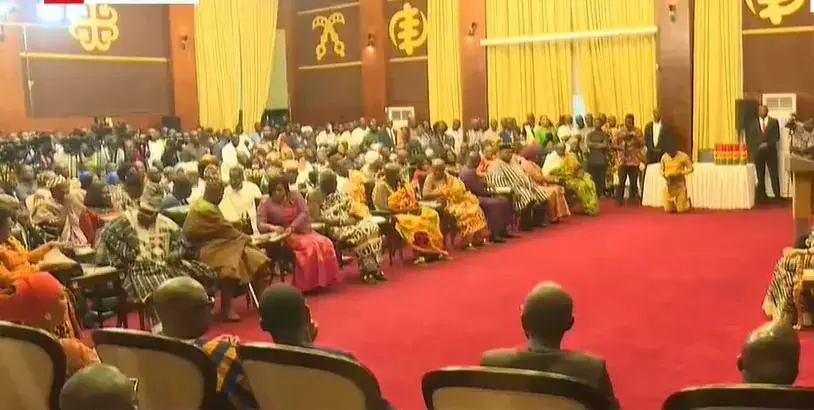
Ghana's Council of State is in need of a major overhaul, according to Cletus Avoka, a former Majority Leader and current member of the Council. Avoka made this statement at an Institute of Economic Affairs (IEA) roundtable on constitutional reform. He emphasized that the Council requires its own financial arrangements to operate independently of the government. This call for reform comes as the constitutional review process heads towards amendment bills.
The Council of State currently faces significant challenges, including a lack of offices for its members. Avoka noted that only the Chairman has an office, while other members are forced to carry their office materials in their car boots. This situation, he said, is reminiscent of the 1993 Parliament. Avoka's comments highlight the need for reform to bring the Council up to date with other institutions, such as Parliament, which has made significant progress.
The Council of State was established under the 1992 Constitution's Articles 89 to 92, with the primary role of advising the President. The Council comprises a former Chief Justice, a former Chief of Defence Staff, a former Inspector-General of Police, and the National House of Chiefs' president, among others. However, its advisory role is not binding, and the President and other authorities are not required to follow its recommendations.
The Constitution Review Committee, established by President John Mahama in January 2025, proposed significant changes to the Council of State. The committee, chaired by Prof H Kwasi Prempeh, recommended a 33-member Council with representation from various sectors, including Parliament, chiefs, and civil society. However, the government rejected this proposal, arguing that the current arrangement strikes the right balance and limits executive control.
The Institute of Economic Affairs (IEA) has expressed concerns about the current system, arguing that it allows the President to choose his own principal advisers. The IEA's Views and Reflections series on the Prempeh Committee's recommendations and the government's response highlights the need for reform. Lawyer Sam Okudzeto chaired the IEA roundtable session, which featured discussions on the constitutional review process.
The constitutional review process is ongoing, with the government presenting its position on the report in July. The government has proposed two amendment bills: one for non-entrenched provisions and one for entrenched provisions, which must go to a referendum. The Council of State is expected to advise on both bills. An 11-member Constitution Review Implementation Committee has been established to prepare the draft bills.
The review process has garnered significant attention from stakeholders, including former Chief Justice Sophia Akuffo, who urged that the review process be moved forward to ensure democracy leads to development. Prof Prempeh has also called for the draft bills to be published for public scrutiny before they are finalized. The government's aim is to hold the referendum alongside the 2027 District Assembly elections.
Key points
- The Council of State requires its own budget and offices to work independently of government.
- The Council of State's advisory role is not binding on the President and other authorities.
- The constitutional review process aims to reform the Council of State and other aspects of Ghana's constitution.