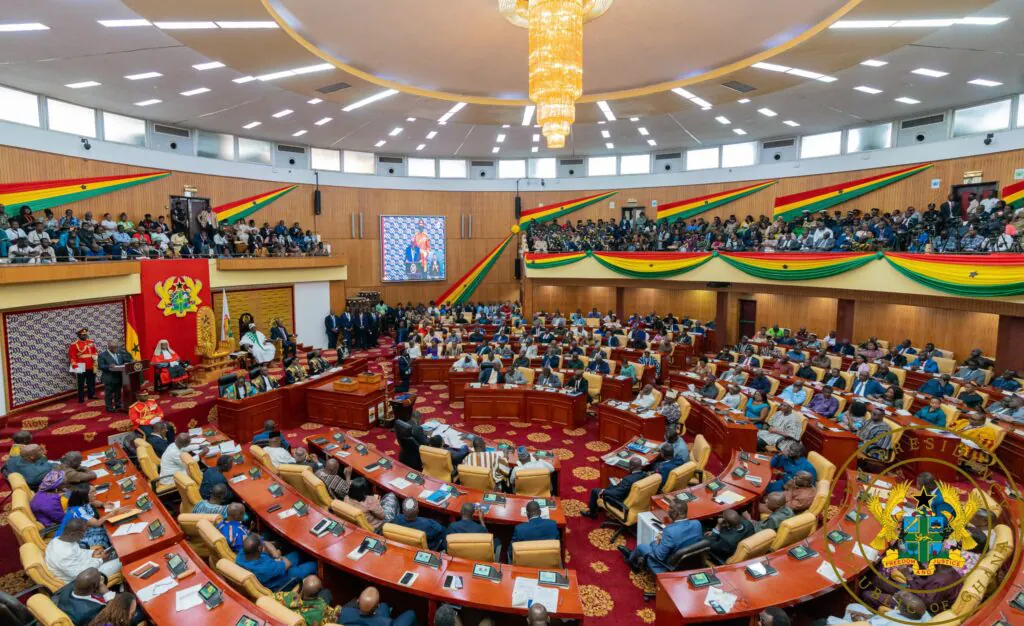
An attempt by the Economic and Organised Crime Office (EOCO) to arrest Nana Agyei Baffour Awuah, the Member of Parliament (MP) for Manhyia South, at an Accra High Court on September 23, 2023, has reignited discussions about the immunity of MPs enshrined in Articles 117 and 118 of Ghana's 1992 Constitution. This incident has highlighted the perceived protection that prevents security agencies from arresting or inviting lawmakers for questioning without the Speaker's permission.
Article 117 of the 1992 Constitution states that civil or criminal processes from any court or place outside Parliament cannot be served on or executed in relation to the Speaker, an MP, or the Clerk while they are attending or returning from parliamentary proceedings. Article 118(1) adds that these individuals cannot be compelled to appear as witnesses in any court or place outside Parliament while attending parliamentary business. However, this protection is limited in time and place, safeguarding the parliamentary function rather than the MP as a person.
According to Prince Ganaku, a private legal practitioner and Partner at Benchmark Lawyers, the constitutional text is clearer than the practice surrounding it. He explained that the immunity does not shield an MP from investigation nor does it require the Speaker's permission before the criminal law can act. The uncertainty arises from the practice that has developed over time, particularly under former Speakers Professor Aaron Mike Oquaye and Alban Bagbin, where agencies would route requests through the Speaker while Parliament is in session.
During parliamentary sessions, a convention has developed where security agencies seeking to engage with an MP would send their requests through the Speaker, who then arranges for them to do so. However, when Parliament is in recess, Article 117's protection generally does not apply, except for MPs attending committee sittings or other parliamentary business. In such cases, the protection applies, and a Speaker's certificate of attendance serves as conclusive evidence.
The processes involved in serving sitting MPs with court papers have been tied to Parliament being in session. According to Ganaku, nothing in the Constitution necessitates that agencies must write to the Speaker and the Clerk during recess. The exception lies in verifying whether parliamentary business existed during recess, which can be confirmed by a Speaker's certificate of attendance.
The immunity accorded to MPs continues to be a topic of discussion, especially when an MP is arrested or an attempt is made to arrest them. The recent incident involving the MP for Manhyia South has brought attention to the suitability and applicability of the constitutional immunity. The debate centers on whether the current practice aligns with the constitutional provisions and the extent to which it shields MPs from arrest or investigation.
The issue of MP immunity has significant implications for the balance between parliamentary privilege and the enforcement of the law. As Ghana's parliamentary processes continue to evolve, it is essential to examine the constitutional provisions and their practical applications to ensure clarity and consistency. This will help prevent misunderstandings and misapplications of the law, ultimately upholding the principles of justice and parliamentary accountability.
Key points
- The immunity of Ghanaian MPs under Article 117 of the 1992 Constitution is limited in time and place, protecting the parliamentary function rather than the MP as a person.