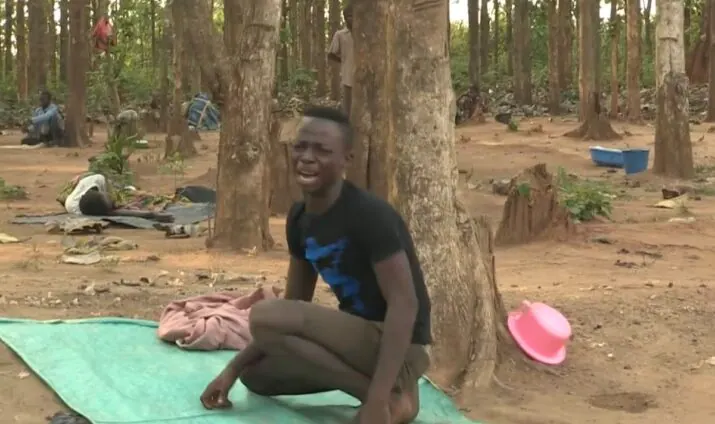
At just eight years old, Hafiz Abdallah was taken to Nyinbonya, a prayer camp in Paga, near Ghana's border with Burkina Faso. His mother, struggling to manage his increasingly erratic behavior after the death of his twin brother, sought help at the facility. For eight years, Hafiz has lived at Nyinbonya without a clinical diagnosis, his mother says, often chained when his behavior becomes unmanageable. "He doesn't even speak, stands often in his own world," she explained. Hafiz's story highlights a broader issue in Ghana, where families often turn to prayer camps and traditional healers for mental health issues, rather than seeking professional medical help.
Clinical psychologist and University of Ghana lecturer Emmanuel Asampong attributes this phenomenon to how illness is understood in Ghanaian culture. "We have usually relied on what we would say is a biopsychosocial approach to seeking health," he said. When faced with unexplained or disturbing behavior, families often attribute it to spiritual dimensions. This approach can lead to children with conditions requiring professional assessment being treated in prayer camps or traditional healing centers, sometimes for years. Asampong notes that this is a complex issue, deeply rooted in Ghanaian culture and society.
A visit to Nyinbonya revealed a facility with tightly controlled access, where children and adults walked barefoot, some appearing malnourished and disassociated. Staff were seen pinching and slapping patients to make them behave or stop screaming. A caregiver, who spoke anonymously, said the facility was doing its best and could accommodate almost 200 patients. However, the conditions at Nyinbonya raise concerns about the treatment and well-being of its residents. The facility's approach to managing patients' behavior has been criticized by mental health professionals.
Sarah Adjei's experience at a prayer camp was marked by intense prayer, healing, and deliverance sessions. She was just seven when she was sexually assaulted by a family acquaintance, leading to severe distress and nightmares. Her parents took her to a church, believing she had a spiritual problem. Sarah remained at the church for years, subjected to fasting and prayer sessions. Now 21 and studying psychology at the University of Ghana, Sarah believes she needed professional mental health support. Her story illustrates the potential harm of mistaking trauma for spiritual possession.
Psychiatrist Dr. Abigail Harding of Korle Bu Teaching Hospital emphasizes that mental illness is a medical condition requiring humane, evidence-based treatment. She notes that practices like chaining, forced fasting, and isolation can further traumatize patients and delay effective treatment. Harding stresses the importance of collaboration between mental health professionals and faith-based providers, while ensuring that treatment respects patients' human rights and dignity. The Ghanaian government has a role to play in regulating faith-based centers and providing accessible psychiatric services.
The shortage of mental health professionals in Ghana is a significant barrier to accessing care. Dr. Josephine Stiles Darko, deputy head of communications at Ghana's Mental Health Authority, notes that the country has only a little over 80 psychiatrists, mostly based in Accra. To address this issue, the Authority is training district health personnel to identify and treat some conditions at the primary level, with severe cases referred to specialist facilities. The goal is to bring mental health care closer to communities, reducing the reliance on prayer camps and traditional healers.
Experts like Asampong and Harding suggest that the solution lies in collaboration between mental health professionals and faith-based providers. By working together, they can develop a system that respects the cultural and spiritual values of Ghanaian families while providing effective, evidence-based treatment. The M-HEALER project, which trains traditionalists and prayer-center operators, is an example of this approach. Ultimately, stronger regulation of faith-based centers, public education, and accessible psychiatric services are needed to address the complex mental health needs of Ghanaian communities.
Key points
- Many Ghanaian families turn to prayer camps and traditional healers for mental health issues, rather than seeking professional medical help.
- The shortage of mental health professionals in Ghana is a significant barrier to accessing care.
- Collaboration between mental health professionals and faith-based providers is crucial to developing an effective mental health system in Ghana.