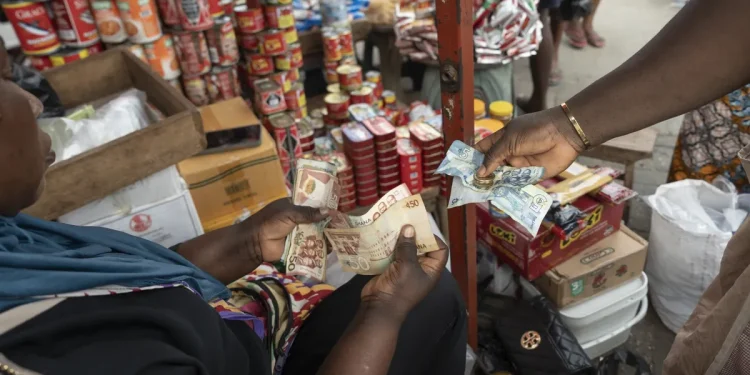
The Ghana cedi emerged as the most depreciated currency in Africa during the second quarter of 2026, according to the World Bank's October 2026 Africa Economic Update. The report attributed the cedi's decline to the escalation of the conflict in the Middle East, which led to a surge in oil and energy prices. This increase in prices put pressure on the cedi, causing it to weaken significantly against the US dollar. The World Bank monitored various African currencies and found that the cedi's depreciation was the largest during the period.
The World Bank's report revealed that several African currencies experienced significant depreciation during Q2 2026. The currencies of Lesotho, Namibia, South Africa, and Eswatini followed the cedi, each recording a maximum depreciation of about 7%. The Seychelles rupee also weakened by nearly 7%, while the Democratic Republic of Congo and Uganda recorded maximum declines of approximately 6% and 5%, respectively. In contrast, currencies such as those of Botswana, Zambia, and Mauritius experienced comparatively smaller periods of maximum weakening, generally ranging between 3% and 5%.
The World Bank identified the surge in oil and energy prices as a key factor behind the depreciation of African currencies. Countries that rely heavily on energy imports faced increased import costs and demand for US dollars, putting additional pressure on foreign exchange reserves and local currencies. Geopolitical uncertainty also played a role, as investors sought safer assets and reallocated capital away from emerging and frontier markets, creating additional pressure on African currencies.
The depreciation of African currencies had significant implications for countries with substantial external debt. A weaker local currency increased the domestic-currency cost of servicing debt denominated in US dollars, adding to existing fiscal pressures. The World Bank noted that the effects of the external shock were uneven across Sub-Saharan Africa, with countries facing different levels of exposure depending on their energy needs, foreign exchange buffers, and debt obligations.
Despite recording the largest maximum weakening between March and June, the Ghana cedi regained some ground in the months that followed. By the end of August, the cedi had eased significantly from its peak, although it remained below its end-February level. The World Bank's data showed that currency pressures across much of Africa had moderated by August, with only 10 currencies remaining weaker than their end-February levels.
The World Bank's report highlighted the varying degrees of exposure faced by African countries to the external shock. Economies with high energy needs, limited foreign exchange buffers, and significant debt obligations were more vulnerable to the effects of the conflict. The report also noted that the pressure on African currencies was widespread, although the extent varied from one country to another.
The World Bank's Africa Economic Update provides valuable insights into the impact of global events on African economies. The report's findings underscore the need for African countries to develop strategies to mitigate the effects of external shocks on their currencies and economies. By understanding the factors driving currency movements, policymakers can take informed decisions to stabilize their currencies and promote economic stability.
Key points
- The Ghana cedi recorded the highest depreciation among African currencies monitored by the World Bank during Q2 2026, weakening by nearly 10% between March and June.
- The World Bank linked the depreciation across African currencies partly to the surge in oil and energy prices that followed the escalation of the Middle East conflict.
- Despite recording the largest maximum weakening, the cedi regained some ground by August, easing significantly from its peak.