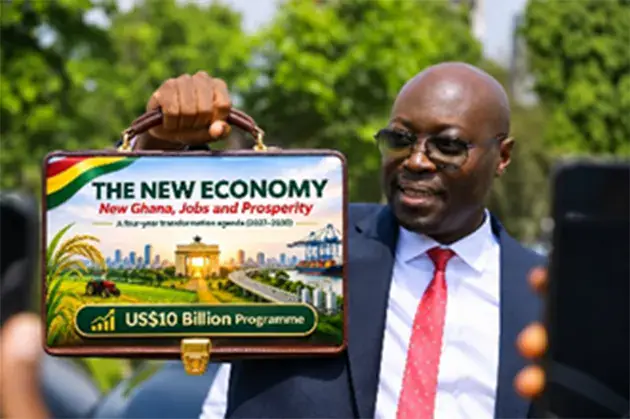
The Ghanaian government has unveiled a bold, four-year plan dubbed the "New Economy," aimed at transforming the country from a raw-material exporter into an industrial, value-adding powerhouse. The US$10 billion masterplan, presented in the 2027 Budget Statement and Economic Policy, outlines eight ambitious pillars, including building a US$3 billion commercial agriculture sector and a US$2 billion energy infrastructure backbone. Finance Minister Cassiel Ato Forson presented the plan to Parliament on November 12, 2026.
The plan proposes significant investments in various sectors, including a US$1.5 billion critical minerals value addition enclave, US$1 billion each for tourism, textiles, and pharmaceuticals, and US$300 million for technology. The government also plans to establish state-owned thermal and solar plants and a 24-hour critical minerals enclave. Additionally, proposed procurement rules would require public institutions to buy only locally grown rice and locally sewn uniforms. The plan aims to make Ghana self-reliant and industrialized.
However, three major risks threaten to derail the grand agenda. The first risk is political, with Ghana's history of frequent changes in government posing a challenge to the plan's continuity. The New Economy is designed as a four-year programme stretching from 2027 to 2030, but Ghana goes to the polls in December 2028, at the programme's halfway mark. A change in government could lead to a shift in priorities and a lack of commitment to the plan.
The second risk is revenue-related, with the government planning to invest a staggering GH¢30 billion in 2027 alone. This investment is supposed to be funded by cutting the primary surplus target by one percentage point of GDP and relying on tax reforms and compliance measures. However, achieving this level of revenue mobilisation is a significant challenge, given historical challenges in VAT compliance and a heavy reliance on a narrow tax base.
The third risk is procurement-related, with the potential for corruption and state capture. The plan involves a significant capital injection into the economy, which could be vulnerable to abuse if procurement processes are not transparent and robust. The budget proposes amending public procurement laws, but implementation will be crucial to preventing corruption and ensuring that contracts are awarded fairly and transparently.
To mitigate these risks, the writer suggests that the New Economy plan should be put on a statutory footing, with ring-fenced funding and annual progress reports to Parliament. Additionally, procurement processes should be transparent, with every contract, its price, and the beneficial owners of the winning bidder published. This would help to prevent corruption and ensure that the plan is implemented effectively.
The 2027 Budget gives Ghana a destination worth striving for, but disciplined execution is crucial to its success. The plan has the potential to transform Ghana into an industrial powerhouse, but it requires careful implementation, aggressive revenue mobilisation, and robust procurement processes. If executed effectively, the New Economy plan could be a significant step towards Ghana's development and industrialisation.
Key points
- The plan faces three major risks: political, revenue-related, and procurement-related.
- The government plans to invest GH¢30 billion in 2027 alone to fund the plan.
- The plan aims to transform Ghana into an industrial powerhouse, with a focus on value addition and self-reliance.