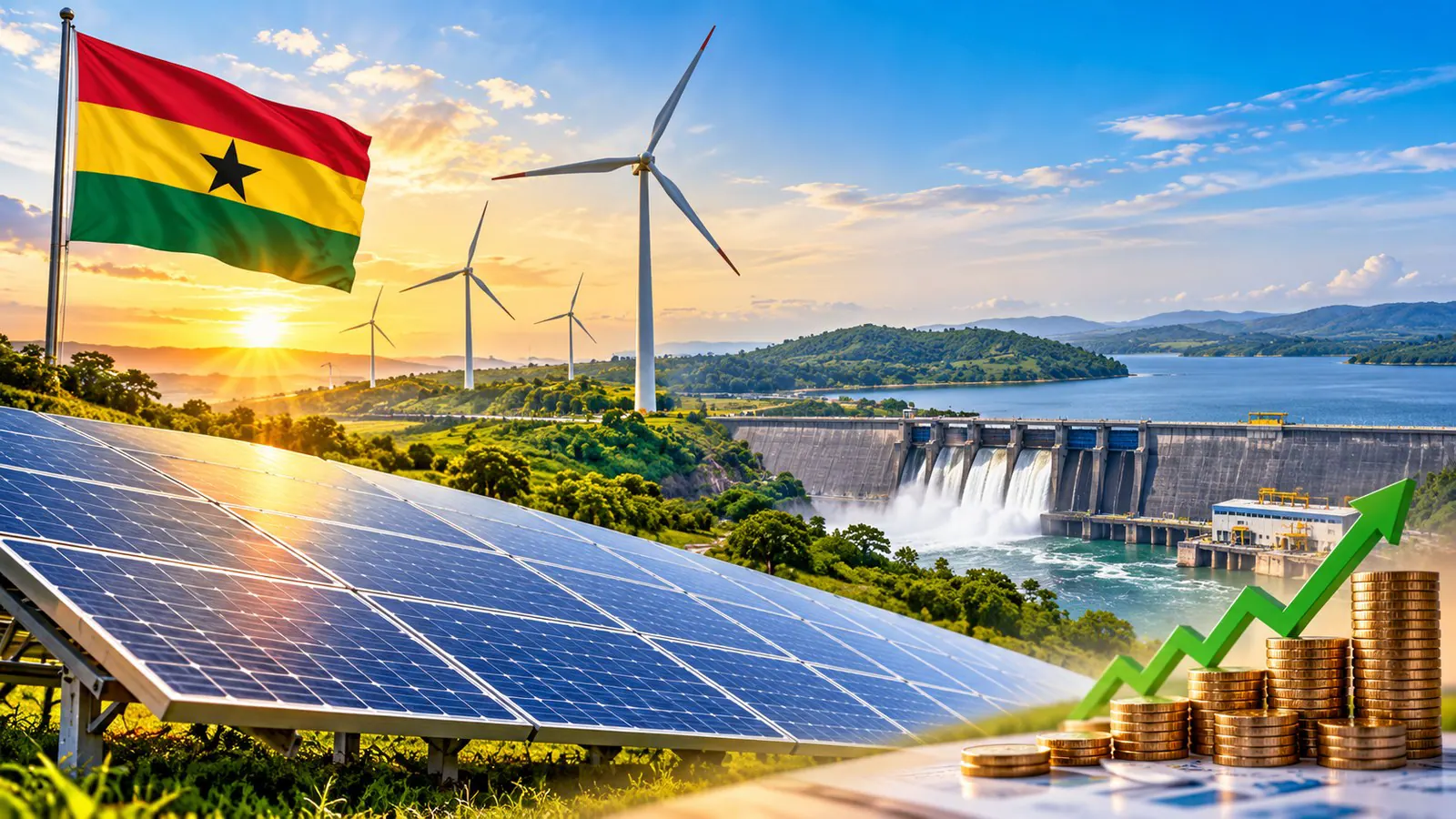
Ghana's Ministry of Energy and Green Transition estimates that the country requires more than $500 billion to achieve net-zero emissions by 2070. This staggering figure has sparked a heated debate about the potential risks and benefits of such a massive investment. The country's recent experience with debt restructuring has raised concerns about the feasibility of taking on additional debt, even for a cause as widely supported as clean energy.
The debate took center stage at a National Policy Dialogue on "Transitioning to a Just and Sustainable Renewable Energy Future" held in Accra, organized by ActionAid Ghana. Experts and government officials discussed the need for a "just" transition that goes beyond environmental outcomes to consider who benefits and who absorbs the costs. John Nkaw, Country Director of ActionAid Ghana, emphasized that the transition must prioritize the needs of workers, women, young people, and affected communities.
ActionAid's global research has highlighted the risks associated with debt and climate action. According to the organization's 2026 study, "Debt Fuels the Climate Crisis: How the Finance Flows," the world's most climate-vulnerable nations spent $304.8 billion servicing debt in 2026, compared to just $12.3 billion on climate action. This finding has significant implications for countries like Ghana, which must navigate the challenges of debt and climate action.
Seth Mahu, Director of Renewable Energy and Green Transition at the Ministry, pushed back on framing the $500 billion figure as a liability. He argued that the transition could deliver energy security, lower costs, industrial growth, and jobs if handled properly. The government's roadmap targets renewables reaching 10 percent of installed capacity by 2030, climbing to 26 percent by 2040, and settling near 20 percent by 2070.
Concrete projects are already underway, including a Solar Street Lighting Programme targeting 125,000 units, with procurement started for an initial 30,000 units. Eight mini-grids have been commissioned, connecting more than 15,000 people, with 35 more under construction expected to reach over 70,000 residents. The government plans to build more than 200 mini-grids by 2030 in pursuit of near-universal electricity access.
Dr. Charles Gyamfi Ofori, Policy Lead for Climate Change and Energy Transition at the Africa Centre for Energy Policy (ACEP), raised concerns that Ghana risks treating the transition as purely a Ministry of Energy project rather than an economy-wide development agenda. He suggested that Ghana could capture significant value through aluminium mounting structures, recycling of end-of-life panels, and ethanol value chains.
The Ministry is exploring a Water-Energy-Food Nexus approach, using solar power for irrigation and portable solar pumps to extend farming beyond the rainy season. Electricity access figures illustrate the importance of this effort, with Ghana's lighting access rate rising from 43.8 percent in 2000 to 86.3 percent in 2021, but a stark urban-rural gap remains.
Key points
- Ghana needs over $500 billion to reach net-zero emissions by 2070.
- The country's recent debt restructuring has raised concerns about the feasibility of taking on additional debt.
- Experts emphasize the need for a "just" transition that prioritizes the needs of workers, women, young people, and affected communities.