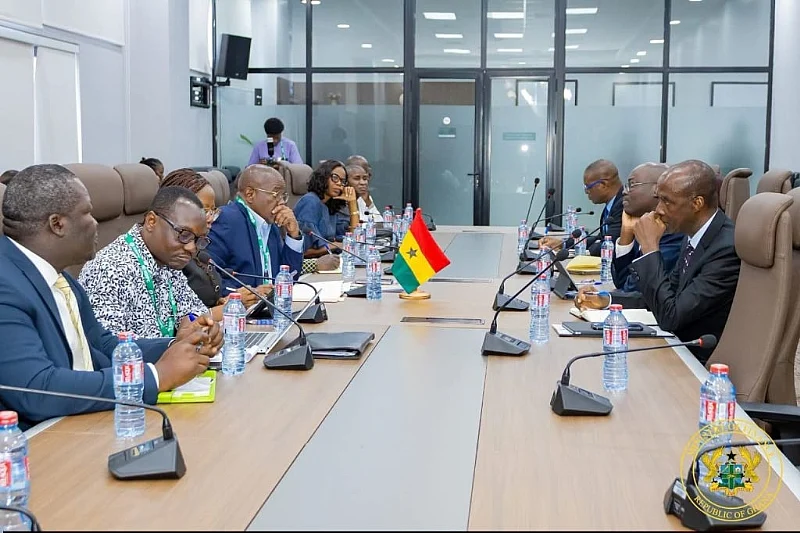
The Ghanaian government has unveiled its 2026 budget, outlining a total expenditure of GH¢357.1 billion. This figure is equivalent to approximately GH¢10,000 for every man, woman, and child in the country. The budget, presented by the Finance Minister, is a critical financial statement that determines tax rates, government borrowing, and allocations for various sectors such as roads, schools, hospitals, and salaries.
The government's revenue target for 2026 is GH¢268.1 billion, comprising revenue and grants. Non-oil tax revenue is projected at GH¢216.1 billion, accounting for 80.6% of total revenue. This tax revenue comes from various sources, including income and property taxes, taxes on domestic goods and services, and customs duties on imports. The 2026 budget introduced measures to increase tax collection, such as raising the VAT registration threshold and deploying technology to monitor cross-border digital transactions.
In addition to taxes, the government collects non-tax revenue from fees, charges, fines, and other sources, estimated at GH¢20.9 billion for 2026. Oil and gas receipts are projected at GH¢13.6 billion, driven by improved efficiency across producing fields and steady global oil prices. Grants from development partners are expected to be GH¢3.1 billion, entirely project-related and supporting key development initiatives.
The government's largest expenditure item is compensation of employees, budgeted at GH¢90.8 billion. This includes wages, salaries, pensions, gratuities, and social security contributions for public sector workers. Interest payments on debt are projected at GH¢57.7 billion, with GH¢50.1 billion going toward domestic interest. Capital expenditure is budgeted at GH¢57.5 billion, including GH¢30 billion for the Big Push Infrastructure Programme.
By mid-2026, the government had paid GH¢48.8 billion in compensation, including GH¢4 billion in SSNIT and Tier 2 Pension Scheme contributions. Interest payments totaled GH¢21.5 billion, with US$700 million for Eurobond debt service and GH¢10 billion to domestic bondholders. The government had also paid GH¢11.5 billion in capital expenditure and GH¢6.5 billion into the Big Push Infrastructure Programme.
The budget targets a primary surplus of 1.5% of GDP, indicating that the government is collecting more than it spends on everything except interest payments. However, after interest payments, the budget remains in deficit, requiring borrowing to finance. A former Finance Minister noted that rigid items like wages, interest, and statutory transfers consume more than two-thirds of total spending, leaving limited room for transformative investments.
The 2026 budget allocates GH¢13.2 billion for goods and services, covering day-to-day costs of running ministries, departments, and agencies. The budget also makes provisions for social protection and education, although specific allocations for these sectors are not detailed. The government's budget implementation will be closely monitored, as it seeks to balance revenue collection, expenditure management, and economic growth.
Key points
- The 2026 budget outlines a total expenditure of GH¢357.1 billion, with a revenue target of GH¢268.1 billion.
- Non-oil tax revenue is projected at GH¢216.1 billion, accounting for 80.6% of total revenue.
- Compensation of employees is the largest expenditure item, budgeted at GH¢90.8 billion.