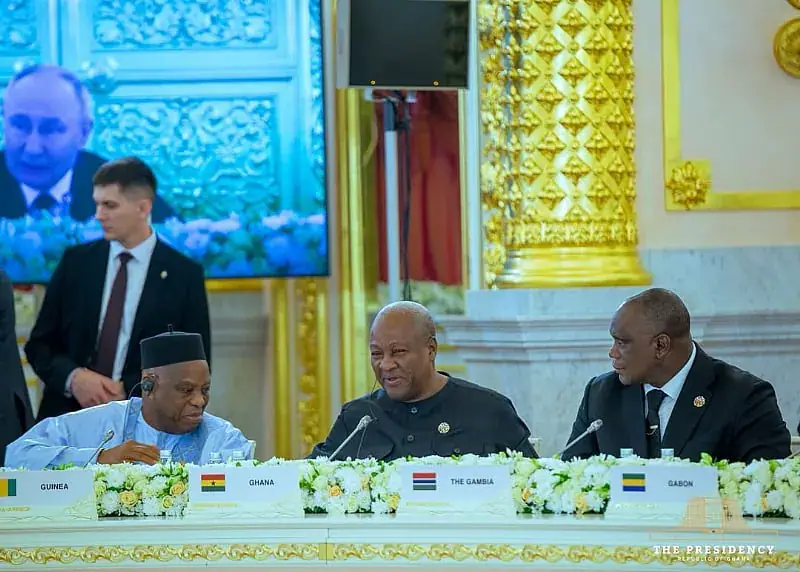
Ghanaian President John Dramani Mahama and Russian President Vladimir Putin have secured key commitments to deepen cooperation between their countries in energy, defence, agriculture, and education. The agreements were reached during the Russia-Africa Summit in Moscow. Ghana's Foreign Affairs Minister, Samuel Okudzeto Ablakwa, issued a statement confirming the agreements. The partnerships aim to strengthen Ghana's energy security and provide a reliable foundation for its industrialisation drive.
A major outcome of the discussions is Russia's commitment to partner Ghana in establishing a 2,000-megawatt nuclear power plant. The facility is expected to strengthen the country's long-term energy security and provide a reliable foundation for its industrialisation drive. This initiative will revive the nuclear energy vision of Ghana's first President, Osagyefo Dr Kwame Nkrumah. Nkrumah's administration began preparatory work towards developing nuclear power before the February 28, 1966 coup interrupted the process.
The nuclear power plant agreement is considered a historic moment for Ghana. According to Mr Ablakwa, what Osagyefo dreamt of decades ago, Ghana is now bringing to fruition through this strategic partnership with the Russian Federation. The partnership will support Ghana's long-term energy needs and contribute to the country's economic development. The project is expected to have a positive impact on Ghana's energy sector.
In the area of defence, Ghana and Russia have agreed on a new pact. Under the agreement, Ghana is expected to acquire strategic military equipment to enhance the operational capabilities of the Ghana Armed Forces. The equipment will help to modernise the country's defence systems and improve its national security. The agreement is expected to strengthen Ghana's defence capabilities.
Ghana and Russia have also agreed to strengthen agricultural cooperation, particularly in grain production and fertiliser supply. The partnership is expected to support local farmers and contribute to improving Ghana's food security. The agreement will help to increase food production and reduce the country's reliance on imported food products. This partnership is expected to have a positive impact on Ghana's agricultural sector.
On education, Russia has pledged to increase scholarship opportunities for Ghanaian students as part of efforts to expand academic cooperation between the two countries. Ghana currently ranks second among African countries benefiting from Russian scholarship programmes. The increased scholarships will provide more opportunities for Ghanaian students to pursue higher education in Russia.
The agreements between Ghana and Russia are evidence of Ghana's renewed diplomatic engagement and its determination to pursue strategic partnerships that translate into practical benefits for its citizens. According to Mr Ablakwa, the outcomes of the meeting demonstrate Ghana's commitment to strengthening its relationships with other countries and pursuing mutually beneficial partnerships.
Key points
- Ghana and Russia have agreed to establish a 2,000-megawatt nuclear power plant to strengthen Ghana's energy security.
- The two countries have agreed on a new defence pact to enhance the operational capabilities of the Ghana Armed Forces.
- Russia has pledged to increase scholarship opportunities for Ghanaian students to expand academic cooperation between the two countries.