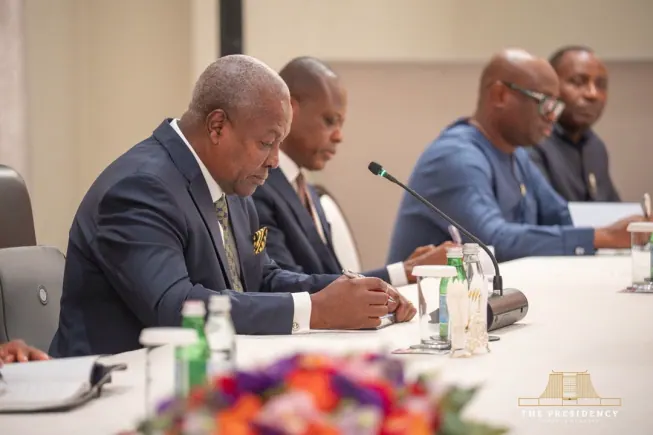
Ghana's President John Dramani Mahama has explained the government's decision to reject a new health compact presented by the United States. The compact was meant to replace funding previously provided under the United States Agency for International Development (USAID). President Mahama described the conditions in the compact as humiliating and an affront to Ghana's sovereignty. The rejection was made during a session at the Council on Foreign Relations (CFR) in New York.
According to President Mahama, the Ministry of Health studied the compact and presented an Information Paper to Cabinet, flagging several provisions. One of the conditions required Ghana to provide the US with its pathogen profile and medical records. President Mahama questioned the rationale behind such a request, stating that no country should be required to surrender its medical records to another country.
The compact also required Ghana to commit a set amount of money as counterpart funding. Additionally, it stipulated that medications or medical products brought into the country under the programme would not be subject to inspection by the Food and Drugs Authority (FDA). President Mahama stated that these conditions made the compact humiliating, leading to its swift rejection by Cabinet.
The rejection of the compact was part of a broader discussion on the Accra Reset initiative. President Mahama explained that the initiative was triggered by the abrupt withdrawal of US aid support, which created a significant gap in the education and health sectors. The health sector alone suffered a $74 million shortfall annually, affecting critical areas such as medical research and HIV and AIDS testing laboratories.
The withdrawal of US aid support compelled the government to make emergency budgetary provisions to cover the gap. This development reignited the conversation on Africa's health sovereignty. President Mahama stated that the objective of the Accra Reset was to break dependencies and achieve health sovereignty by producing more medicines and vaccines on the continent.
President Mahama recalled the lessons of the COVID-19 pandemic, when Africa was the last in the queue to receive vaccines. He emphasized that the continent must build capacity to produce its own medicines and vaccines ahead of future pandemics. The Accra Reset aimed to improve health outcomes and ensure that health remained a central pillar of Africa's development.
Ghana's decision to reject the health compact was not isolated, as other African countries expressed similar concerns about data governance in their negotiations with the US. Zimbabwe and Kenya also raised concerns and stalled the implementation of their agreements. The Council on Foreign Relations, where President Mahama made his remarks, is a non-profit organisation focused on US foreign policy and international relations.
Key points
- Ghana rejected a proposed bilateral health deal with the US due to concerns over sovereignty and data governance.
- The rejection was part of a broader discussion on the Accra Reset initiative, aimed at achieving health sovereignty in Africa.
- Other African countries, including Zimbabwe and Kenya, also expressed concerns about data governance in their negotiations with the US.