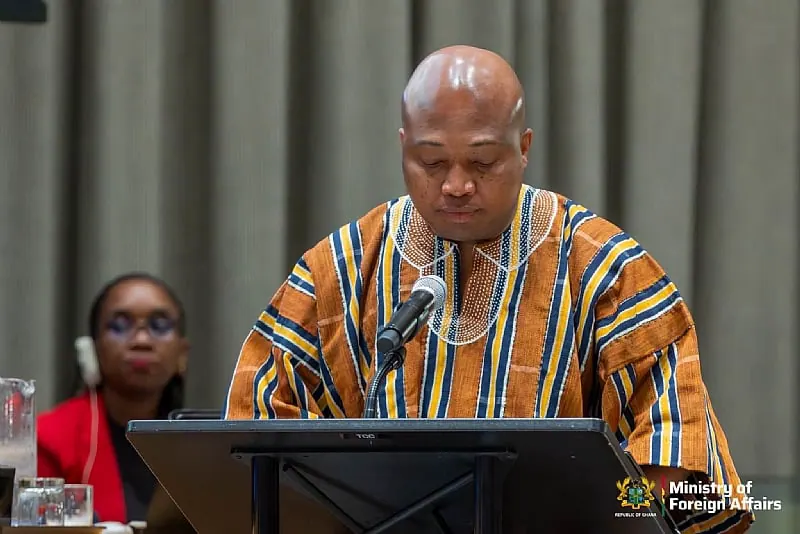
Ghana's Foreign Affairs Minister, Samuel Okudzeto Ablakwa, has reaffirmed his country's support for the International Criminal Court (ICC) at a United Nations high-level commemorative session. The session marked the 25th anniversary of the Durban Declaration and Programme of Action, adopted in 2001 to combat racism, racial discrimination, xenophobia, and related intolerance. Mr. Ablakwa called for stronger international action against racism, discrimination, and crimes against humanity. The Minister made the remarks in New York on Monday, September 28.
The Durban Declaration provides an international framework for combating racism, and its adoption has led to increased international cooperation on the issue. However, Mr. Ablakwa expressed concern that, 25 years after the declaration, racism, intolerance, and discrimination still persist. He cited examples of extreme intolerance, violence, and discrimination, including genocide in Palestine, xenophobia in South Africa, and attacks on minorities such as Rohingya Muslims and African Americans. These issues remain a significant challenge to the international community.
Mr. Ablakwa highlighted Ghana's efforts at the United Nations to secure recognition of the historical roots of racial discrimination. These efforts aim to build a more equitable international system. He cited UN General Assembly Resolution A/RES/80/250, which Ghana spearheaded and which was adopted on March 25, 2026. The resolution declares the trafficking of enslaved Africans and the racialized chattel enslavement of Africans as "the gravest crime against humanity."
The resolution was adopted with 123 votes in favor, three against, and 52 abstentions. According to Mr. Ablakwa, this resolution could support further discussions on apologies, the return of looted cultural heritage, and other forms of reparatory justice. The Minister also referenced remarks by Brazilian President Luiz Inácio Lula da Silva, who described the vote on Ghana's resolution as one of the most important votes in the UN's 81-year history.
Mr. Ablakwa emphasized Ghana's commitment to international mechanisms for addressing serious violations of human rights. He highlighted the Ghana-led landmark UN Resolution declaring the transatlantic enslavement and racialized chattel as the gravest crime against humanity. This resolution is a historic step towards acknowledging the root cause of discrimination, injustice, and inequality.
The Minister's statement on social media on Wednesday, September 30, underscored Ghana's dedication to addressing racism and discrimination. He expressed concern about the continued occurrence of these issues decades after the Durban Declaration. Mr. Ablakwa's remarks reflect Ghana's ongoing efforts to promote a more equitable international system and to address the legacy of racial discrimination.
The UN high-level commemorative session demonstrates the international community's ongoing commitment to combating racism and discrimination. Ghana's support for the ICC and its efforts to promote reparatory justice reflect its dedication to addressing these issues. The country's initiatives at the UN aim to build a more just and equitable international system.
Key points
- Ghana reaffirms its support for the International Criminal Court at a UN high-level session marking the 25th anniversary of the Durban Declaration.
- The country cites a UN General Assembly resolution declaring the trafficking of enslaved Africans as "the gravest crime against humanity."
- Ghana emphasizes its commitment to international mechanisms for addressing serious violations of human rights.